
- Blog
- |
- 16 Oct 2025
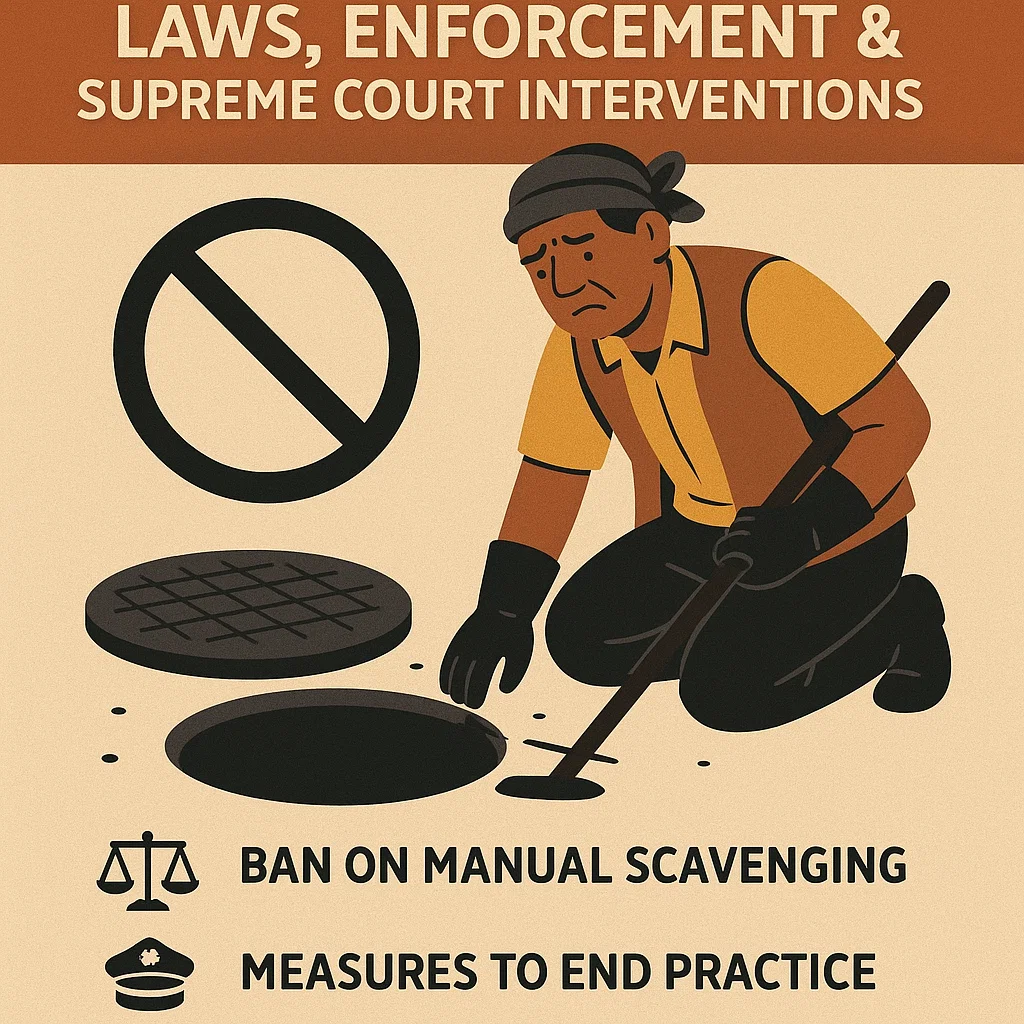
Manual Scavenging Ban in India: Laws, Enforcement & Supreme Court Interventions
Manual scavenging is one of the most degrading and hazardous forms of labour that still exists in India, despite being legally banned for decades. It involves the manual cleaning, carrying, disposing, or handling of human excreta from dry latrines, open drains, septic tanks, or sewers without the use of protective gear or proper mechanical equipment. The work is often done by hand using basic tools like buckets, brooms, and baskets, and in many cases workers enter septic tanks or sewer lines directly, exposing themselves to poisonous gases and life-threatening conditions.
Historically, this occupation is closely linked to the caste system in India, where certain Dalit communities particularly those categorised as “Valmiki” or “Hela” in some regions were forced to take up this work as a hereditary duty. It was not a matter of free choice but a result of centuries of discrimination, untouchability, and denial of alternative livelihood opportunities. Even today, the practice carries immense social stigma, leading to exclusion and humiliation of those engaged in it.
The Indian Constitution, adopted in 1950, promised equality, dignity, and non-discrimination to all citizens. It outlawed untouchability under Article 17 and guaranteed the right to life and personal liberty under Article 21, which has been interpreted by the Supreme Court to include the right to live with dignity. On paper, these provisions make manual scavenging unconstitutional. However, the persistence of the practice reveals a deep gap between legal ideals and ground reality.
Recognising the inhuman nature of manual scavenging, the government has introduced laws to prohibit and eliminate it. The first major legal step was the Employment of Manual Scavengers and Construction of Dry Latrines (Prohibition) Act, 1993, which sought to ban both the practice and the building of dry latrines that require manual cleaning. However, poor enforcement and lack of political will meant that manual scavenging continued almost unchanged in many states.
A stronger and more comprehensive law the Prohibition of Employment as Manual Scavengers and their Rehabilitation Act, 2013 was enacted to address these shortcomings. This law not only prohibited the employment of manual scavengers but also extended the ban to hazardous manual cleaning of sewers and septic tanks. It also introduced provisions for rehabilitation, skill training, and alternative livelihoods for those engaged in manual scavenging.
The Supreme Court has played a crucial role in pushing for the eradication of this practice through landmark judgments, particularly in the case of Safai Karamchari Andolan v. Union of India (2014), where it declared manual scavenging a violation of fundamental rights, directed strict enforcement of the 2013 Act, and mandated compensation to families of workers who died while cleaning sewers or septic tanks.Despite these legal measures and judicial interventions, manual scavenging still exists in various forms across the country. Reports of sewer deaths, lack of protective equipment, and coercion into this work continue to emerge. The persistence of manual scavenging reflects the intersection of caste-based discrimination, poverty, and state failure to enforce laws effectively.
Therefore, understanding the ban on manual scavenging in India requires not only a study of the laws and rules in place but also an examination of how they are enforced, what the Supreme Court has done to strengthen them, and why challenges remain. The issue is not only legal but deeply social and moral it tests the country’s commitment to the dignity and equality of its most marginalised citizens.
CONSTITUTIONAL BASIS
The Indian Constitution is the supreme law of the land, and it lays the foundation for eliminating practices like manual scavenging. Even before specific laws were enacted, the principles within the Constitution made it clear that such work violates the dignity, equality, and freedom of individuals. Several Articles directly or indirectly prohibit manual scavenging by outlawing untouchability, forced labour, and discrimination, while guaranteeing equality and the right to live with dignity.
Article 14 – Equality before Law
Article 14 guarantees that every person is equal before the law and entitled to equal protection of the laws within the territory of India. Manual scavenging, being caste-based and assigned to certain communities, clearly violates this principle. Assigning degrading work to a specific group purely because of caste denies them equal treatment and perpetuates inequality.
Article 15 – Prohibition of Discrimination
Article 15 prohibits discrimination by the State on grounds of religion, race, caste, sex, or place of birth. Manual scavenging is a caste-linked occupation, and denying other employment opportunities to those communities amounts to discrimination. By this provision, the State has a duty to ensure that no citizen is compelled to do this work simply because of their caste identity.
Article 17 – Abolition of Untouchability
Article 17 explicitly abolishes “untouchability” and forbids its practice in any form. The term “untouchability” is not limited to physical contact but includes social exclusion and degrading treatment based on caste. Manual scavenging is a direct outcome of the untouchability mindset — it treats certain people as “polluted” or “unclean” and forces them into menial, degrading work. Under this Article, the practice is unconstitutional.
Article 21 – Right to Life and Personal Liberty
Article 21 states that no person shall be deprived of their life or personal liberty except according to procedure established by law. The Supreme Court has interpreted “life” to mean not just physical survival but a life of dignity, free from exploitation and humiliation. Forcing someone to clean human waste without protective equipment, and exposing them to deadly sewer gases, is a denial of this right to live with dignity and safety.
Article 23 – Prohibition of Forced Labour
Article 23 prohibits “begar” (unpaid labour) and other forms of forced labour. While manual scavenging is sometimes paid, it often operates under social, economic, and caste pressure that leaves no real choice for the worker. The Supreme Court has clarified that even if someone is paid, if they are compelled to work in inhuman conditions due to caste or poverty, it still counts as forced labour under Article 23.
Directive Principles of State Policy (DPSPs)
Although not enforceable in court, the Directive Principles guide the State in policy-making. Several DPSPs support the elimination of manual scavenging, such as:
Article 38 – Promotes social, economic, and political justice.
Article 39(e) – Directs the State to ensure that workers are not forced to do jobs that are harmful to their health.
Article 41 – Promotes the right to work and humane conditions of employment.
Article 46 – Directs the State to protect the interests of Scheduled Castes and other weaker sections from social injustice and exploitation.
LEGISLATIVE FRAMEWORK
The fight against manual scavenging in India has not been limited to moral appeals or constitutional promises. Over the years, Parliament has enacted specific laws to criminalise the practice, prohibit the construction of insanitary latrines, and rehabilitate those engaged in such work. The legislative journey has evolved in two major phases — the 1993 Act, which was the first attempt, and the stronger 2013 Act, which now governs the issue.
Employment of Manual Scavengers and Construction of Dry Latrines (Prohibition) Act, 1993
This was India’s first central law aimed specifically at ending manual scavenging.
Objective – To ban the employment of manual scavengers and prohibit the construction or use of dry latrines that require manual cleaning.
Definitions – The Act defined “manual scavenger” and “dry latrine” to identify the prohibited practices.
Prohibitions –
Outlawed the employment of any person as a manual scavenger.
Prohibited construction of new dry latrines and use of existing ones.
Implementation – Required states to implement the ban, but only if they adopted the Act through a state resolution (since sanitation is a State subject under the Constitution).
Penalties – Provided for simple imprisonment up to one year or a fine up to ₹2,000 or both for violations.
Limitations –
The Act was weak in enforcement because it depended on states to adopt it voluntarily.
The penalties were minor.
There was no strong rehabilitation mechanism for those already engaged in manual scavenging.
Sewer and septic tank cleaning was not covered.
Due to these shortcomings, manual scavenging continued almost unchanged in many parts of India despite the 1993 law.
Prohibition of Employment as Manual Scavengers and their Rehabilitation Act, 2013
Recognising the failure of the earlier law, Parliament passed this stronger, more comprehensive legislation, which came into force on 6 December 2013.
Objective – To completely eliminate manual scavenging, hazardous cleaning of sewers and septic tanks, and to rehabilitate affected workers with dignity.
Key Definitions – Expanded the definition of “manual scavenger” to include anyone engaged in manual cleaning of insanitary latrines, open drains, pits, septic tanks, or sewers without protective gear.
Prohibitions –
Ban on employment of any person as a manual scavenger.
Ban on construction or maintenance of insanitary latrines.
Ban on hazardous manual cleaning of sewers and septic tanks without mechanical devices or protective equipment.
Surveys and Identification –
Local authorities must carry out surveys within their jurisdiction to identify insanitary latrines and manual scavengers.
Surveys must be completed within a fixed time frame, and identified insanitary latrines must be converted to sanitary ones.
Rehabilitation Measures –
One-time cash assistance.
Scholarships for children of manual scavengers.
Allotment of residential plots and financial assistance for house construction.
Skill training and provision of alternative livelihood.
Access to concessional loans and subsidies.
Penalties –
First offence: imprisonment up to one year or fine up to ₹50,000 or both.
Subsequent offences: imprisonment up to two years or fine up to ₹1,00,000 or both.
Responsibility –
Local bodies, railway authorities, and cantonment boards must ensure the implementation of the Act.
The law applies uniformly across the country without requiring state adoption.
Rules and Schemes Linked to the Law
Prohibition of Employment as Manual Scavengers and their Rehabilitation Rules, 2013 – Provide detailed procedures for surveys, rehabilitation benefits, and monitoring.
Self Employment Scheme for Rehabilitation of Manual Scavengers (SRMS) – A central scheme providing cash assistance, loans, and training for alternative employment.
Swachh Bharat Mission – Though primarily aimed at sanitation and open defecation-free status, it indirectly supports manual scavenging elimination by promoting sanitary toilets.
Distinction between 1993 and 2013 Acts
The 2013 Act is far more comprehensive than the 1993 Act because:
It covers sewer and septic tank cleaning.
It applies across India automatically.
It has stronger penalties.
It includes rehabilitation as a statutory right.
It mandates surveys and deadlines for eliminating insanitary latrines.
ENFORCEMENT MECHANISMS
Passing strong laws against manual scavenging is only the first step. The real test lies in their enforcement — how the government machinery ensures that the ban is followed, violations are punished, and affected individuals are rehabilitated. In India, enforcement is a shared responsibility between the central government, state governments, and local authorities, with specific roles assigned under the law.
Role of Local Authorities
Under the 2013 Act, local bodies such as municipalities, panchayats, cantonment boards, and railway authorities have direct responsibility to:
Identify insanitary latrines in their jurisdiction through surveys.
Ensure conversion of insanitary latrines into sanitary ones within a fixed time frame.
Identify and release persons employed as manual scavengers from such work.
Facilitate rehabilitation measures, including providing financial assistance and skill training.
Local authorities are considered the first line of enforcement because they are closest to the ground realities. However, reports show that in many cases, they either delay surveys or underreport the number of manual scavengers to avoid administrative or political pressure.
State Government Responsibilities
State governments are tasked with overseeing and coordinating enforcement within their territories. Their key duties include:
Framing state-level rules under the 2013 Act to give effect to its provisions.
Appointing appropriate authorities and inspectors to monitor compliance.
Setting up vigilance and monitoring committees at the state and district levels.
Submitting annual reports on implementation to the central government.
Ensuring that offenders are prosecuted promptly under the Act.
Many state governments have been criticised for inadequate data collection, poor follow-up, and lack of budget allocation for rehabilitation schemes.
Central Government Oversight
The Ministry of Social Justice and Empowerment is the nodal ministry at the central level. Its responsibilities include:
Laying down policies and guidelines for nationwide implementation.
Monitoring state compliance and collecting implementation reports.
Running the Self Employment Scheme for Rehabilitation of Manual Scavengers (SRMS).
Coordinating with other ministries, such as the Ministry of Housing and Urban Affairs and the Ministry of Railways, to ensure sector-specific compliance.
The central government also compiles national statistics on manual scavenging and publishes them periodically, although these figures are often contested by activists as being underreported.
Role of Vigilance and Monitoring Committees
The 2013 Act mandates the formation of:
State Monitoring Committees – Headed by the Chief Minister or a senior minister, these committees review implementation at the state level.
District Monitoring Committees – Headed by the District Magistrate, these committees track progress in identification, prohibition, and rehabilitation.
Sub-Divisional Committees – Oversee implementation in smaller administrative units.
These committees are meant to meet regularly, keep detailed records, and ensure that deadlines for surveys, conversions, and rehabilitation are met.
Role of the Judiciary
Courts, especially High Courts and the Supreme Court, play a key enforcement role when violations are brought to their attention through public interest litigations (PILs). Judicial directions have often been used to push reluctant authorities to act.
Challenges in Enforcement
Despite the clear framework, several barriers weaken enforcement:
Underreporting – Many states deny the presence of manual scavenging to avoid legal responsibility.
Poor Prosecution Rates – Even when violations are reported, prosecutions are rare and conviction rates are low.
Rehabilitation Gaps – Cash assistance is sometimes provided, but skill training and alternative employment are often delayed or absent.
Continued Sewer Deaths – Workers continue to die while cleaning septic tanks and sewers, showing that hazardous cleaning without safety gear still happens widely.
Caste-Based Pressure – Social norms in some areas still force certain communities into this work despite legal bans.
SUPREME COURT INTERVENTIONS
The Supreme Court of India has played a decisive role in pushing the government to act more seriously against manual scavenging. Through landmark judgments, it has expanded the interpretation of constitutional rights, clarified legal obligations under the 2013 Act, and held authorities accountable for violations. The Court has also emphasised that eliminating manual scavenging is not just a statutory requirement but a constitutional imperative linked to the right to life and dignity.
Early Judicial Attention
Before the 2013 Act was passed, the issue of manual scavenging came before the Supreme Court through petitions filed by activists and organisations such as the Safai Karamchari Andolan. These petitions highlighted that despite the 1993 Act, manual scavenging continued widely, and insanitary latrines were still in use. The Court’s observations during these hearings made it clear that the problem was one of enforcement and not of legislative gaps alone.
Safai Karamchari Andolan v. Union of India (2014)
This case is the most significant Supreme Court intervention on manual scavenging. Filed as a public interest litigation, it sought to hold the government accountable for failing to eradicate the practice.
Key Findings and Directions of the Judgment:
Recognition of Manual Scavenging as a Violation of Fundamental Rights
The Court declared that manual scavenging violates Articles 14, 17, and 21 of the Constitution, as it denies equality, continues untouchability, and deprives individuals of the right to live with dignity.Strict Enforcement of the 2013 Act
The Court directed all states and Union territories to fully implement the Prohibition of Employment as Manual Scavengers and their Rehabilitation Act, 2013.Survey and Identification
It ordered all states to complete surveys to identify manual scavengers and insanitary latrines, with deadlines for their demolition or conversion.Rehabilitation Measures
The Court mandated that all persons identified as manual scavengers should be provided with the full range of rehabilitation benefits under the Act, including alternative employment opportunities.Compensation for Sewer Deaths
The Court directed that families of persons who died while cleaning septic tanks or sewers should receive compensation of ₹10 lakh each, regardless of whether the deceased was employed directly by the government or by contractors.Accountability of Officials
It warned that government officials who fail to prevent manual scavenging in their jurisdiction would be held responsible.
Continuing Mandamus
The Court has kept the matter open as a “continuing mandamus,” meaning it can call the parties back for progress reports. This approach is used in cases where ongoing monitoring is needed to ensure compliance.
Emphasis on Dignity and Social Justice
The Supreme Court stressed that the fight against manual scavenging is not just about banning a particular job but about dismantling centuries-old caste-based discrimination and ensuring that affected communities have genuine opportunities for dignified work.
Directions to the Railways
The Court specifically called out the Indian Railways as one of the largest employers of manual scavengers, especially for cleaning railway tracks. It directed the Railways to mechanise cleaning processes and rehabilitate workers.
Impact of the Judgment
This judgment brought renewed national attention to the issue, forcing governments to conduct surveys, release rehabilitation funds, and acknowledge the persistence of the problem. However, implementation remains inconsistent, with activists often returning to court to report ongoing violations.
CONCLUSION
The journey to end manual scavenging in India is both a legal and social struggle. On paper, India has one of the strongest legal frameworks in the world to outlaw this dehumanising practice. The Constitution guarantees equality before the law, prohibits untouchability, and protects the right to life and dignity. Parliament has enacted specific laws from the 1993 prohibition to the more comprehensive 2013 Act that not only criminalise the employment of manual scavengers but also promise rehabilitation and alternative livelihoods. The Supreme Court has reinforced these rights through landmark judgments, especially in Safai Karamchari Andolan v. Union of India, by linking the ban to fundamental rights and holding authorities accountable.
Yet, the reality on the ground tells a more troubling story. Manual scavenging, in both its traditional form and through hazardous cleaning of sewers and septic tanks, continues in many parts of the country. The persistence of the practice is a direct reflection of weak enforcement, administrative apathy, caste-based discrimination, and deep-rooted social stigma. Surveys are often incomplete or manipulated, prosecutions are rare, and rehabilitation measures are inconsistently implemented. The continued deaths of workers in septic tanks and sewers — despite clear legal prohibitions — highlight the gap between the law’s promise and its actual delivery.
Ending manual scavenging requires more than laws and court orders. It demands sustained political will, strict accountability for officials, adequate funding, and genuine rehabilitation that enables workers to leave this occupation permanently. It also requires dismantling the caste prejudices that have historically confined certain communities to this work. Mechanisation of sanitation, universal access to sanitary toilets, and community-level awareness are essential for lasting change.
In the end, the elimination of manual scavenging is not just about compliance with a statute; it is a moral test for the nation. It asks whether India, 75+ years after independence, can uphold the dignity of its most marginalised citizens. The law provides the tools, and the courts provide the guidance — but only the collective resolve of government, civil society, and citizens can ensure that no one is forced to clean another person’s waste by hand ever again. True freedom and equality will be realised only when manual scavenging becomes a relic of the past, remembered not as an ongoing shame but as a hard-won victory for human dignity
Sources
The Prohibition of Employment as Manual Scavengers and Their Rehabilitation Act, 2013 – Official text of the Act.
Safai Karamchari Andolan & Ors. vs. Union of India (2014) – Supreme Court judgment laying down guidelines for the rehabilitation of manual scavengers.
Repealing and Amending Act, 2015 – Legislative amendments related to manual scavenging laws.
News Reports:
Times of India – Coverage of incidents and legal proceedings related to manual scavenging deaths.
The Hindu – Reporting on Supreme Court directions and government responses.
Legal Analysis:
LiveLaw – Articles discussing Supreme Court rulings and enforcement challenges.
Bar & Bench – Analyses of legal developments and government actions.
Human Rights Watch Report (2014) – Documentation of manual scavenging practices and their impact on Dalit communities.
National Human Rights Commission (NHRC) Reports – Investigations and recommendations on manual scavenging and related human rights issues.
Ministry of Social Justice and Empowerment, Government of India – Official communications and reports on the implementation of manual scavenging laws.
Judicial Orders:
Delhi High Court – Directions for strict compliance with Supreme Court judgments on manual scavenging.
Rajasthan High Court – Orders seeking state government responses on manual scavenger deaths.