
- Blog
- |
- 16 Oct 2025
Land Acquisition Laws in India: LARR Act, Compensation & Legal Rights Explained
1. Why Reform Was Needed: Problems with the Old Law
For many years, India’s land acquisition was governed by a law from the colonial era called the Land Acquisition Act of 1894. This law allowed the government to take private land for public use, but the process was often unfair to landowners. The compensation offered was usually very low, based on outdated land values, and it did not consider the real emotional and economic losses faced by farmers and families who depended on the land for their livelihood. Because of this, many people were displaced without proper rehabilitation or resettlement.
The system often led to protests and unrest, with communities feeling powerless against government projects. One famous example was the Narmada Bachao Andolan, where villagers protested against the building of a dam that threatened to flood their homes and farms. The existing law lacked transparency and failed to protect the rights of vulnerable people, causing widespread dissatisfaction and injustice.
It became clear that India needed a new law that would make land acquisition more transparent, fair, and respectful of people’s rights, ensuring that development projects did not come at the cost of social injustice.
2. The LARR Act (2013): What Changed
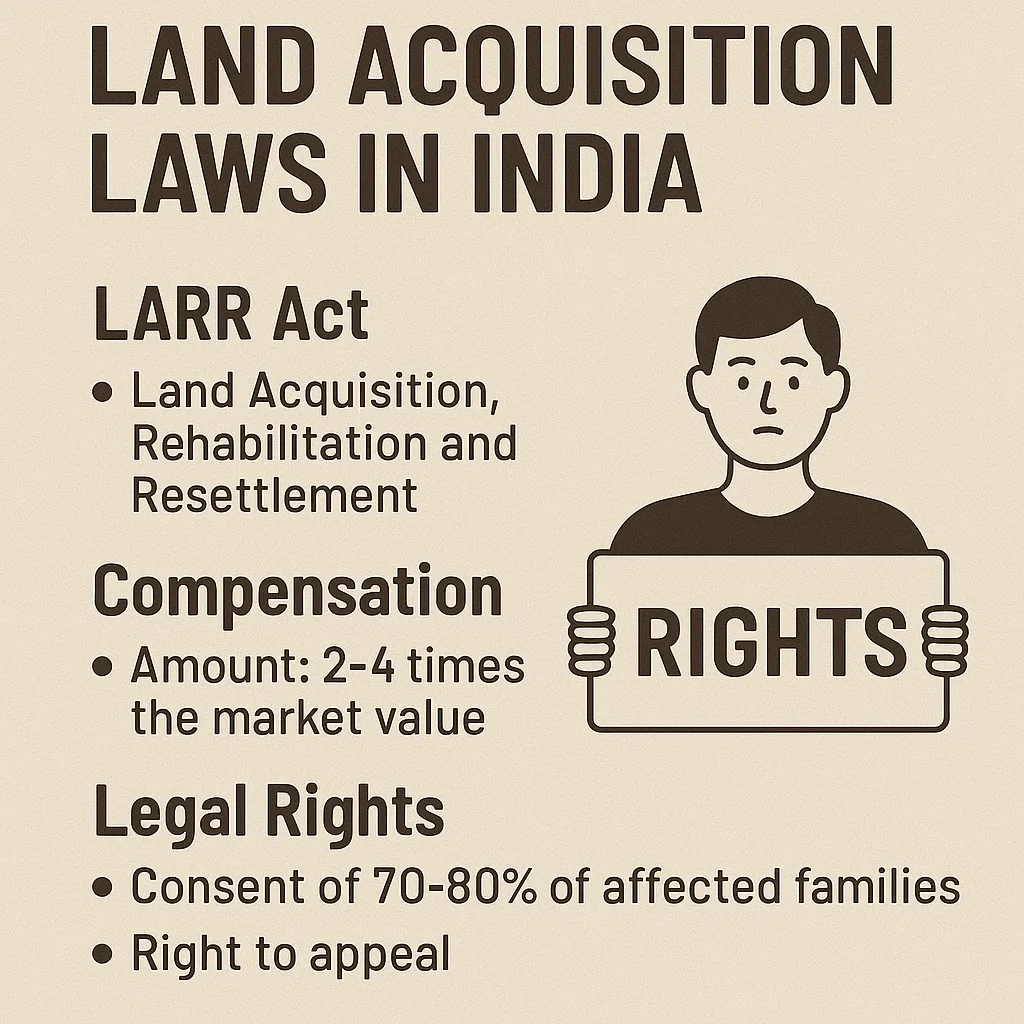
To address these serious issues, the government passed the Right to Fair Compensation and Transparency in Land Acquisition, Rehabilitation and Resettlement Act in 2013, commonly called the LARR Act. This new law marked a significant change from the old system by introducing the principle of consent and ensuring fair compensation and rehabilitation for affected families.
One of the most important changes was the requirement that landowners must give their consent before their land can be acquired for private projects or public-private partnerships. Specifically, the law requires that at least 80% of landowners must agree for private companies’ projects and 70% for public-private partnership projects.
The Act also increased the amount of compensation landowners receive. In rural areas, the compensation must be two to four times the market value of the land, while in urban areas, it must be at least twice the market value. This compensation also includes the value of any buildings or assets on the land, as well as an additional solatium (a kind of compensation for emotional and other losses) equal to 100% of the market value. If the acquisition is delayed, additional compensation must be paid for the delay period as well.
Another key aspect is the Social Impact Assessment (SIA). Before land can be acquired, the government must conduct an SIA to understand how the acquisition will affect the people living there, the environment, infrastructure, and overall community well-being. This assessment helps make sure that the project benefits outweigh the costs and that the affected people’s concerns are taken into account.
The Act also has provisions for rehabilitation and resettlement. This means that families displaced by land acquisition are entitled to housing, job opportunities or compensation allowances, transportation support, and other infrastructure to help them rebuild their lives. Additionally, the law protects agricultural land by restricting acquisition of fertile multi-crop land, which is vital for food security.
Finally, the LARR Act introduces safeguards like the “use it or return it” clause. This means that if the acquired land is not used within five years, it must be returned to the original owners, ensuring that land is not wasted or held without purpose.
3. Compensation: What Landowners Are Entitled To
1. Market Value of the Land
The starting point for compensation is the “market value” of the land being acquired. This is the price the land would fetch if sold in an open and competitive market. Importantly, the Act requires this market value to be based on the average sale price of similar land within the previous three years in the nearby area, not just the official government “circle rates” which are often lower.
This ensures that compensation reflects the true current value of the land rather than outdated or artificially low figures.
2. Multiplier Based on Location
To make compensation more just, the Act mandates a multiplier to be applied to the market value, which varies depending on the location of the land:
In rural areas, the compensation must be between two to four times the market value, depending on factors like the proximity to urban centers or infrastructure development.
In urban areas, the compensation must be at least twice the market value.
This multiplier recognizes that landowners often lose future income potential or opportunities when their land is acquired, and aims to compensate for those broader losses.
3. Value of Assets on Land
If the land has any buildings, trees, crops, or other structures, the compensation must also include their value. For example:
Houses, sheds, wells, or fences on the land.
Fruit-bearing trees or other valuable vegetation.
Standing crops or agricultural produce at the time of acquisition.
The idea is that landowners should be fully compensated for everything they lose, not just the land itself.
4. Solatium – Additional Compensation for Distress
The law provides for an extra payment called solatium, which is compensation for the emotional, social, and economic distress caused by losing land. This amount is usually equal to 100% of the market value (i.e., an amount equal to the basic compensation) and is intended to recognize the hardship of displacement.
Solatium helps to address the non-monetary impact such as disruption of community ties, loss of ancestral land, and loss of livelihood.
5. Interest for Delay in Payment
If the acquiring authority delays paying the compensation beyond the stipulated period, the affected landowners are entitled to interest on the delayed amount. This provision protects landowners from financial hardship due to bureaucratic delays and encourages timely payment.
6. Rehabilitation and Resettlement Allowances
Compensation is not limited to just paying for the land lost. Under the LARR Act, affected families are also entitled to rehabilitation and resettlement benefits such as:
Alternative housing or land.
Monthly financial assistance or annuity to replace lost income.
Transportation allowances for shifting to new locations.
Job opportunities or training to help displaced persons regain livelihoods.
These benefits are particularly important for those who depend on agriculture or local businesses for survival, helping them to rebuild their lives after displacement.
4. Recent Developments and Real-World Examples
In recent years, India has seen several important developments aimed at improving land acquisition practices:
The Ministry of Road Transport and Highways has set strict timelines for land acquisition and environmental clearances for national highway projects to speed up development while ensuring fairness and compliance with the law. This move helps avoid long delays that hurt both communities and infrastructure projects.
In Punjab, a recent government plan to pool land for urban development was challenged in court because it did not follow proper procedures like Social Impact Assessment and obtaining consent from landowners. The Punjab and Haryana High Court put a temporary stay on the policy, showing how courts are actively protecting landowners’ rights and enforcing the law.
In the city of Agra, land acquisition for a large housing project was done through mutual agreement with farmers. The compensation was paid at four times the circle rate (official land value), and the process was transparent and cooperative. This project is often cited as an example of how fair and collaborative land acquisition can work, benefiting both developers and landowners.
These examples highlight the progress India is making in balancing development needs with social justice, ensuring that land acquisition is done responsibly and with respect for all stakeholders.
5. The Importance of Fair Land Acquisition for Inclusive and Sustainable Development
Land acquisition is a sensitive but necessary process for a country’s growth, whether for building roads, factories, schools, or hospitals. However, the way it is done greatly affects how inclusive and sustainable that development will be.
When landowners’ rights are protected and compensation is fair, communities are less likely to resist projects, leading to smoother execution and lasting benefits. The LARR Act’s framework aims to build trust between the government, developers, and citizens by ensuring transparency and respect for property rights.
For rural and tribal populations, land is often their primary source of income and identity. Protecting their interests through proper compensation and rehabilitation safeguards their social and economic wellbeing. This, in turn, supports long-term stability and prevents displacement-related poverty.
Ultimately, fair land acquisition is essential for achieving development that benefits all sections of society, balancing economic progress with social justice and human dignity.
Legal Rights Explained
1. Right to Fair and Adequate Compensation
One of the most important rights under the LARR Act is the assurance that landowners will receive compensation that is not only fair but also adequate to cover the actual value of the land and the losses suffered. The Act mandates compensation to be at least two to four times the market value of the land in rural areas and at least twice the market value in urban areas. This multiplier varies based on the location and type of land.
Compensation is calculated on several factors:
The market value of the land itself.
The value of any buildings, trees, or crops present on the land.
Solatium, which is an additional payment (usually 100% of the market value) as compensation for the emotional and other losses caused by displacement.
Interest for any delay in payment beyond the stipulated time.
This structure ensures that the landowners are not shortchanged and that their losses are comprehensively compensated.
2. Right to Rehabilitation and Resettlement (R&R)
Land acquisition often means that people have to move from their homes and lose their sources of livelihood. Understanding this, the LARR Act includes detailed provisions for rehabilitation and resettlement, which are legal rights of the displaced families. This is not limited to cash compensation but includes:
Alternative housing or land to settle in a new location.
Employment or financial assistance, such as monthly annuities, to restore income levels.
Support for vulnerable groups, including Scheduled Castes, Scheduled Tribes, and other marginalized communities.
Transportation allowances and support for shifting belongings.
Infrastructure facilities such as schools, roads, and health centers in resettlement colonies to help affected families rebuild their lives.
These measures aim to minimize the social and economic disruption caused by displacement and promote the long-term welfare of affected persons.
3. Right to Participation and Consent
Unlike previous laws where landowners had little say, the LARR Act gives them the right to participate in the acquisition process. For acquisitions related to private companies or public-private partnership projects, the Act requires that a minimum percentage of landowners (80% in private projects and 70% in PPP projects) must consent before acquisition proceeds. This provision ensures that acquisition is a collective decision, not an imposed action.
Additionally, the law mandates a Social Impact Assessment (SIA), a detailed study conducted in consultation with affected people, which evaluates the consequences of acquisition on communities, livelihoods, environment, and culture. This assessment is published and discussed publicly, giving landowners and citizens a platform to raise concerns or objections.
4. Right to Transparent and Timely Process
The law also protects the rights of affected people by ensuring the acquisition process is transparent and completed within a reasonable time frame. Compensation must be paid before taking possession of the land, and delays in compensation payment are liable to interest charges. This prevents landowners from being left in uncertainty or financial hardship during prolonged acquisition proceedings.
If the acquired land is not used for the intended purpose within five years, it must be returned to the original owners, preventing misuse or indefinite holding of land by the government or developers.
5. Right to Legal Recourse and Dispute Resolution
If landowners or affected families believe their rights have been violated—whether in terms of inadequate compensation, improper rehabilitation, or procedural lapses—they have the right to approach legal authorities. The Act provides for mechanisms to file objections, complaints, and appeals to ensure their grievances are heard and addressed.
Special authorities or tribunals may be appointed to oversee disputes, and courts can intervene to protect citizens from unfair practices. This legal recourse strengthens the position of landowners and ensures accountability.
Conclusion
India’s land acquisition laws have evolved significantly from the colonial-era rules to the modern, people-friendly framework under the LARR Act of 2013. While challenges remain, especially in timely implementation and ensuring consent, the law provides a strong foundation for fair compensation and protection of rights.
This transformation is crucial for India’s development journey. It ensures that projects serving the nation’s growth do not trample on the rights of its people, especially those who have historically been vulnerable.
With ongoing judicial oversight, government reforms, and active citizen participation, India is moving toward a future where land acquisition balances progress with justice—making development truly inclusive and fair.
SOURCES
The Right to Fair Compensation and Transparency in Land Acquisition, Rehabilitation and Resettlement Act, 2013 (LARR Act) — Official text and amendments.
Ministry of Rural Development, Government of India — Reports and guidelines on land acquisition and rehabilitation.
National Rehabilitation and Resettlement Policy, Government of India.
Law Commission of India Reports on Land Acquisition (especially Report No. 176).
Scholarly articles and legal commentaries on land acquisition, compensation, and rehabilitation laws in India.
Books on Indian Property Law and Land Acquisition by eminent legal scholars.
Reports and studies by National and State Human Rights Commissions relating to land acquisition and rehabilitation issues.
Articles from reputed legal journals and economic research institutes on the impact of the LARR Act.