
- Blog
- |
- 16 Oct 2025
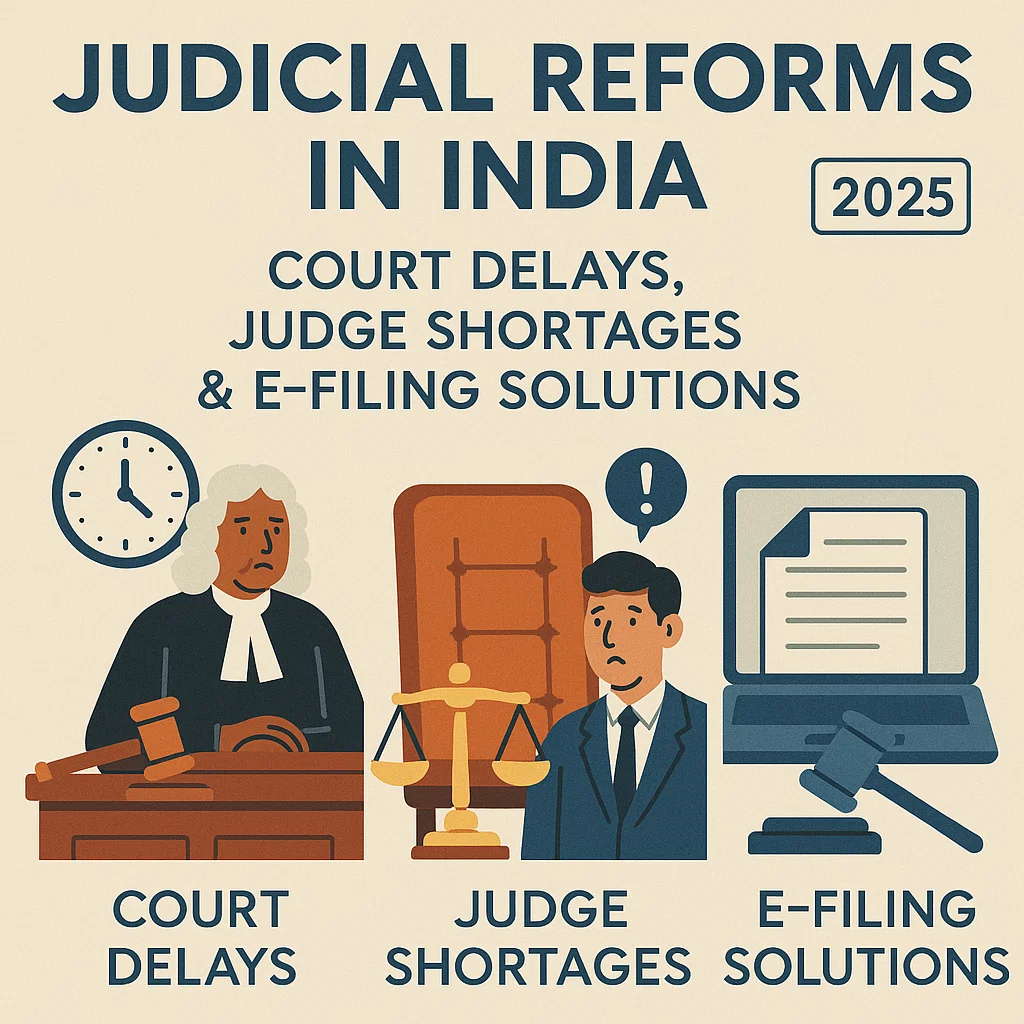
Judicial Reforms in India: Court Delays, Judge Shortages & E-Filing Solutions (2025)
Introduction to Judicial Inefficiencies in India
The Indian judicial system plays a very important role in maintaining law and order, protecting the rights of people, and ensuring that justice is delivered fairly. However, in recent years, the system has been under a lot of pressure. One of the biggest challenges it faces today is the problem of delays in delivering justice. In 2025, the number of pending cases in Indian courts has crossed 5 crore (50 million). This is a serious issue because justice delayed often becomes justice denied.
Many people who approach the courts do so with the hope of getting timely relief. But what they often face is a long, frustrating journey filled with delays, adjournments, and repeated hearings that go on for years. This creates a situation where people lose trust in the legal system. It also affects their personal lives, financial situations, and mental health. In many cases, poor people and weaker sections of society suffer the most because they cannot afford long legal battles.
There are different types of courts in India, such as the Supreme Court, High Courts, District Courts, and lower courts. All these courts are overloaded with cases. Even though the number of cases has been increasing every year, the system has not been able to keep up with the demand. The result is a growing number of pending cases across all levels of the judiciary.
The problem is not only the number of cases but also how the system functions. There are many reasons why court cases take so long. Sometimes lawyers ask for unnecessary delays. Sometimes judges are not available, or the parties involved do not appear in court. Procedures are also very slow and complex. Many of the laws and practices being followed today were created decades ago and are not suited for the fast-paced world we live in now.
Another major issue is the shortage of judges. India has one of the lowest judge-to-population ratios in the world. There are simply not enough judges to hear and decide all the cases in a timely manner. Vacancies in courts are not filled quickly, and even when judges are appointed, they often do not have enough support staff or proper infrastructure to do their work efficiently.
This slow and inefficient system of justice has many negative effects. It increases the cost of legal proceedings, both in terms of time and money. It also discourages people from seeking legal help. In some cases, people take the law into their own hands because they do not believe that the courts will help them on time. This creates a dangerous situation for society and weakens the overall system of governance.In response to this growing crisis, the Indian government and judiciary have started looking at reforms to improve the situation. Some reforms are aimed at improving the functioning of courts by changing procedures and appointing more judges. Others are focused on using technology to make the justice system faster and more accessible. For example, e-filing of cases, online hearings, and digital case tracking systems have been introduced in many courts.These new technologies have helped in some areas, especially during the COVID-19 pandemic, when physical movement was restricted. However, these solutions are not enough on their own. They need to be implemented properly and backed by training, awareness, and infrastructure support. Digital reforms must reach every part of the country, not just the big cities. Rural courts still face many challenges in going digital, such as lack of internet, poor infrastructure, and lack of technical skills among court staff and lawyers.The A country like India, with over 1.4 billion people, cannot afford to have a slow and outdated justice system. A strong and efficient judiciary is necessary for protecting rights, supporting economic growth, maintaining law and order, and building public trust in democracy.
Court Delays: Causes and Consequences
One of the biggest problems in the Indian legal system is the delay in deciding cases. Court delays are not new, but the situation has become worse in recent years. People often have to wait for many years sometimes decades for a final decision in their case. These delays affect both civil and criminal cases and can lead to serious problems for individuals and for society.
There are many reasons behind these long delays in the court system. One of the main causes is the large number of cases that come to the courts every year. The Indian population is huge, and with rising awareness of rights, more people are going to court to seek justice. However, the number of judges and court staff has not increased at the same rate. This has created a big gap between the demand for justice and the system’s ability to deliver it.
Another reason for delays is the complex and outdated legal procedures. Many laws and rules were written a long time ago, during British rule, and have not been updated properly. These procedures are often long and difficult to follow. For example, one case may go through many stages: filing, summons, hearings, evidence, cross-examinations, arguments, and appeals. If there are delays at any stage, the entire case slows down.
Adjournments are also a major cause of delay. Lawyers sometimes ask for unnecessary postponements, and courts often grant them. This could be due to the absence of one of the parties, witnesses not showing up, or lawyers being busy with other cases. Repeated adjournments stretch the case timeline, causing frustration to the people involved.
Lack of proper infrastructure is another issue. Many courtrooms do not have enough space or basic facilities. Files and records are still kept in physical form in many places, which makes case management slow and disorganized. In some rural or semi-urban courts, electricity and internet connections are also unreliable, which further delays court operations.
Another factor is the shortage of support staff, such as clerks, stenographers, and court officers. Even if a judge is present and ready, the court cannot function smoothly without adequate staff. The burden on the existing staff is very high, and this results in errors, inefficiencies, and even corruption in some cases.
Delay in appointing judges also contributes to the problem. Even though there are approved (sanctioned) posts for judges in every court, many of these posts remain vacant for long periods due to slow appointment processes. This means fewer judges are available to hear and dispose of cases, which adds to the backlog.
The appeal system in India also contributes to delays. After a case is decided in a lower court, it can be challenged in a higher court. Sometimes, the same case goes through multiple appeals, all the way to the Supreme Court. Each level of appeal takes time and requires fresh hearings, adding to the overall delay.
The consequences of court delays are serious and wide-ranging. Firstly, people lose trust in the justice system. When it takes too long to get a verdict, people may start believing that the system is broken or unfair. In some cases, they may try to settle disputes outside the legal system, which can lead to violence or illegal actions.
Secondly, court delays also affect the economy. For example, if a business dispute takes ten years to resolve, it can harm companies, slow down investments, and affect jobs. Investors and companies may avoid doing business in India if they believe the legal system is too slow or unpredictable.
In criminal cases, delays mean that people who are innocent may have to spend years in jail waiting for their trial. At the same time, guilty people may stay free for years while their case moves slowly through the system. This affects public safety and the right to a fair trial.
Delays also increase the cost of litigation. Every hearing requires money—for lawyers, travel, documents, and time off work. For poor and middle-class people, these expenses can become unbearable. This leads to a situation where only the rich can afford to fight long legal battles, making the system unequal.
Finally, delays put a huge mental and emotional burden on the people involved. Waiting for years to get justice can cause stress, anxiety, and frustration. For victims, it feels like they are being punished again and again
Judge Shortages and Administrative Challenges
One of the biggest reasons for the slow working of Indian courts is the shortage of judges. There are simply not enough judges to handle the huge number of cases that come to the courts every year. This shortage exists at every level of the judiciary—Supreme Court, High Courts, and District Courts. Because of this, many cases keep getting delayed and the number of pending cases keeps growing.
To understand the problem, we can look at some numbers. As of 2025, there are more than 5 crore (50 million) cases pending in Indian courts. But the number of judges is very low when compared to the population. On average, India has only around 20 judges per million people, while many developed countries have between 50 to 100 judges per million people. This makes it very difficult for the existing judges to manage such a large workload.
In District and Subordinate Courts, which handle most of the civil and criminal cases in the country, the shortage is especially severe. There are many posts for judges that remain vacant for long periods. These vacancies are supposed to be filled by state governments and the High Courts, but the process is often slow and delayed. As a result, the burden on the judges who are already working becomes too much.
High Courts also face the same issue. Even though there is a sanctioned strength (approved number) of judges, many of these positions are not filled in time. Appointing High Court judges involves both the central and state governments, along with the Supreme Court Collegium. This multi-step process often leads to delays. Sometimes, appointments are stuck due to political reasons or lack of agreement between authorities.
The Supreme Court, though smaller in size, also faces delays due to a high number of appeals coming from lower courts. Even though the number of judges in the Supreme Court has increased over the years, it is still not enough to handle the heavy caseload efficiently.
Apart from the shortage of judges, the Indian judiciary also suffers from various administrative challenges. First, the appointment process is not transparent or efficient. There is no single, fast, and uniform method of recruiting judges across the country. In the lower judiciary, judges are usually selected through state-level examinations, but the schedule of these exams is irregular, and the process takes a lot of time.
Another issue is the lack of proper training and support for judges. After their appointment, many judges do not receive proper judicial training, especially when it comes to handling complex cases, using digital tools, or managing courtrooms efficiently. Also, many courts do not have enough support staff like clerks, typists, bailiffs, and stenographers. Without this staff, judges are forced to do many small tasks themselves, which wastes their time and reduces their productivity.
Infrastructure problems also affect the functioning of courts. Many court buildings are old and overcrowded. There may not be enough courtrooms, chambers, or waiting areas. In some cases, even basic facilities like clean toilets, proper seating, and electricity are missing. This creates a difficult working environment for judges, lawyers, and the public.
Another serious problem is the lack of modern case management systems. Many courts still rely on paper files and manual registers. Searching for documents or scheduling hearings becomes time-consuming. Digital tools and case tracking systems are being introduced, but the progress is slow, especially in rural and semi-urban courts. Judges often do not receive training or support in using these technologies.
Workload distribution is also a big issue. Some judges handle hundreds of cases every month, while others may have a lighter workload depending on the court or region. There is no uniform system for distributing cases fairly among judges. This uneven workload creates unnecessary delays and stress.
All these challenges reduce the efficiency of the judiciary. Judges are forced to give very little time to each case because they have so many to handle. This increases the chances of errors, appeals, and further delays. It also leads to judicial fatigue where judges are overworked and mentally exhausted.
To improve the situation, India needs strong reforms. First, all judge vacancies must be filled on time. A National Judicial Services Examination could be introduced to select judges fairly and quickly, just like exams are held for other government jobs. Judges also need continuous training, especially in handling modern legal issues and using digital tools.
The court administration should be made more professional by appointing trained court managers to help with scheduling, record-keeping, and staff management. This will allow judges to focus more on deciding cases instead of administrative work.
E-Filing and Digital Reforms: Progress and Limitations
In recent years, India has started using technology to improve the working of its judicial system. One of the most important steps in this direction is the introduction of e-filing and other digital tools in the courts. These changes aim to make the system faster, more transparent, and easier for people to access. While these reforms have made some progress, there are still many challenges that need to be solved before they can truly transform the justice delivery system.
E-filing means that lawyers or individuals can file their cases online without having to visit the court physically. This system allows documents to be submitted through a website or software instead of being filed in person. E-filing saves time, reduces paperwork, and helps in organizing case records in a better way.
The COVID-19 pandemic played a big role in speeding up digital reforms in the judiciary. During the lockdowns, physical court hearings were not possible. As a result, the courts had to shift to virtual hearings using video conferencing tools. This helped courts continue working even during difficult times. After seeing the benefits of virtual courts, many High Courts and even the Supreme Court continued to use digital hearings for some types of cases even after the pandemic.
Another useful step is the National Judicial Data Grid (NJDG), which is an online platform that gives real-time data about pending cases, disposed cases, and the overall performance of courts. This allows judges, lawyers, and the public to monitor the functioning of courts and helps in improving accountability and planning.
Some courts have also introduced automated case listing, cause lists, and e-payment of court fees. This helps reduce human errors and saves a lot of time that was earlier spent on manual tasks.
However, despite these improvements, there are still many limitations and challenges in the use of digital technology in Indian courts.
First, the digital divide is a big problem. Not everyone in India has access to the internet or knows how to use online systems. Many lawyers, especially in rural and small-town areas, are not comfortable with using technology. They lack training and support to use e-filing systems or attend virtual hearings. Even many judges find it difficult to adjust to the new digital environment without proper training.
Second, infrastructure is not equal everywhere. Big cities like Delhi, Mumbai, and Bengaluru have better internet and court facilities. But in many district and taluka-level courts, there are frequent power cuts, slow internet, and outdated computers. Without proper infrastructure, digital reforms cannot work smoothly.
Third, data privacy and security are major concerns. When sensitive case information is stored online or shared during virtual hearings, there is always a risk of data leaks or misuse. Strong cybersecurity systems are needed to protect legal documents and ensure that online hearings are safe and private.
Fourth, the current e-filing systems in many courts are not user-friendly. People who are not tech-savvy, such as senior citizens or those without access to lawyers, find it very hard to file cases on their own. The websites are often slow, full of technical terms, and not available in regional languages. This makes it difficult for common citizens to benefit from the digital reforms.
Also, not all types of cases are suitable for virtual hearings. In criminal cases or cases involving evidence and cross-examination, in-person hearings are often more effective. Witnesses may feel pressured during online hearings, and it may be harder for judges to observe body language or assess credibility. So, a hybrid model may be more suitable, where both physical and virtual hearings are used depending on the type of case.
There is also the issue of standardization. Different High Courts follow different systems and software for e-filing and video conferencing. There is no single platform that is used across the country. This creates confusion and makes it harder for lawyers who practice in multiple states.
To make digital reforms successful, a uniform, nationwide digital platform is needed. All courts should follow a single system, and regular training should be given to judges, lawyers, and court staff. Digital tools should also be made available in multiple Indian languages to ensure access to everyone.
Policy Reforms and Institutional Recommendations
India’s judicial system is facing many problems like long delays, shortage of judges, poor infrastructure, and slow adoption of technology. These problems cannot be solved by small fixes. They require big and well-planned reforms at both the policy and institutional levels. This section explains the kinds of reforms that are needed to make the Indian judiciary faster, more efficient, and accessible to all.
One of the most important reforms is to fill all vacant judge positions quickly. As discussed earlier, many courts across India do not have the full number of judges they are supposed to have. These vacant posts must be filled without delay. The appointment process should be faster, more transparent, and free from political interference. High Courts and the Supreme Court Collegium must work closely with the government to make sure that eligible candidates are appointed on time.
A long-term solution to the judge shortage is to create an All India Judicial Services (AIJS) exam, similar to the IAS or IPS. This would allow young, talented graduates from across the country to join the judiciary through a competitive and fair process. It would also create uniformity and bring new energy into the lower courts, where most cases begin.
Another important area of reform is judicial infrastructure. Many courts in India still operate in poor conditions with old buildings, broken furniture, no proper electricity, and no digital tools. The government must invest more in building modern court complexes with proper courtrooms, libraries, waiting areas, and digital infrastructure. Each judge should have trained support staff like clerks, stenographers, and assistants to help manage cases better.The use of technology must also be expanded and improved. E-filing, virtual hearings, digital case management, and online tracking systems should be made compulsory in all courts. But for this to work, the technology must be easy to use, available in local languages, and supported by proper training for judges, lawyers, and court staff. A single digital platform should be created for use by all courts in the country so that the system becomes unified and efficient.
Another key reform is to simplify court procedures. Many laws and legal processes are too old, slow, and full of complicated language. The government and judiciary should work together to update outdated laws and remove unnecessary steps in court procedures. This will help reduce delays and make the legal system easier to understand for ordinary citizens.
To ensure that judges and court staff are well-prepared, regular judicial training and capacity building programs are necessary. Judges must stay updated on new laws, changes in society, use of digital tools, and modern case management practices. The National Judicial Academy and State Judicial Academies must play a bigger role in organizing such programs.
SOURCES
Department of Justice, Ministry of Law and Justice, Government of IndiaWebsite: https://doj.gov.in
Official updates on judicial infrastructure, e-Courts Mission Mode Project, and sanctioned judge strength.
e-Courts Project Phase II & III – National Informatics Centre
Website: https://ecourts.gov.in
Details India’s efforts in digitizing court records, introducing e-filing and virtual courts.
Law Commission of India, Reports
Notable Reports:
Report No. 245 (2014) on Arrears and Backlog
Report No. 230 (2009) on Reforms in the Judiciary
Website: http://lawcommissionofindia.nic.in
Supreme Court of India – Annual Reports
Available on the Supreme Court’s official website: https://main.sci.gov.in
Provides updates on judge strength, pending cases, and judicial functioning.
NITI Aayog – Strategy for New India @75 (2018)
Document proposes creation of an All India Judicial Services (AIJS) and improving access to justice.
Source: https://niti.gov.in
Vidhi Centre for Legal Policy
Independent research and policy think tank focusing on judicial and legal reforms.
Reports on judicial delays, e-filing usage, and court performance: https://vidhilegalpolicy.in
India Justice Report (2023) – By Tata Trusts and DAKSH
Offers detailed analysis of judge vacancies, court infrastructure, and case pendency state-wise.
Website: https://www.indiajusticereport.org
Parliamentary Standing Committee on Law and Justice (Various Reports)
Gives recommendations on judge appointments, judicial vacancies, infrastructure funding, and training.
Available on: https://loksabhadocs.nic.in
Articles from Bar & Bench / LiveLaw / The Hindu / Indian Express
Provide journalistic analysis and interviews with judges, lawyers, and court officials on ongoing reforms