- Blog
- |
- 16 Oct 2025
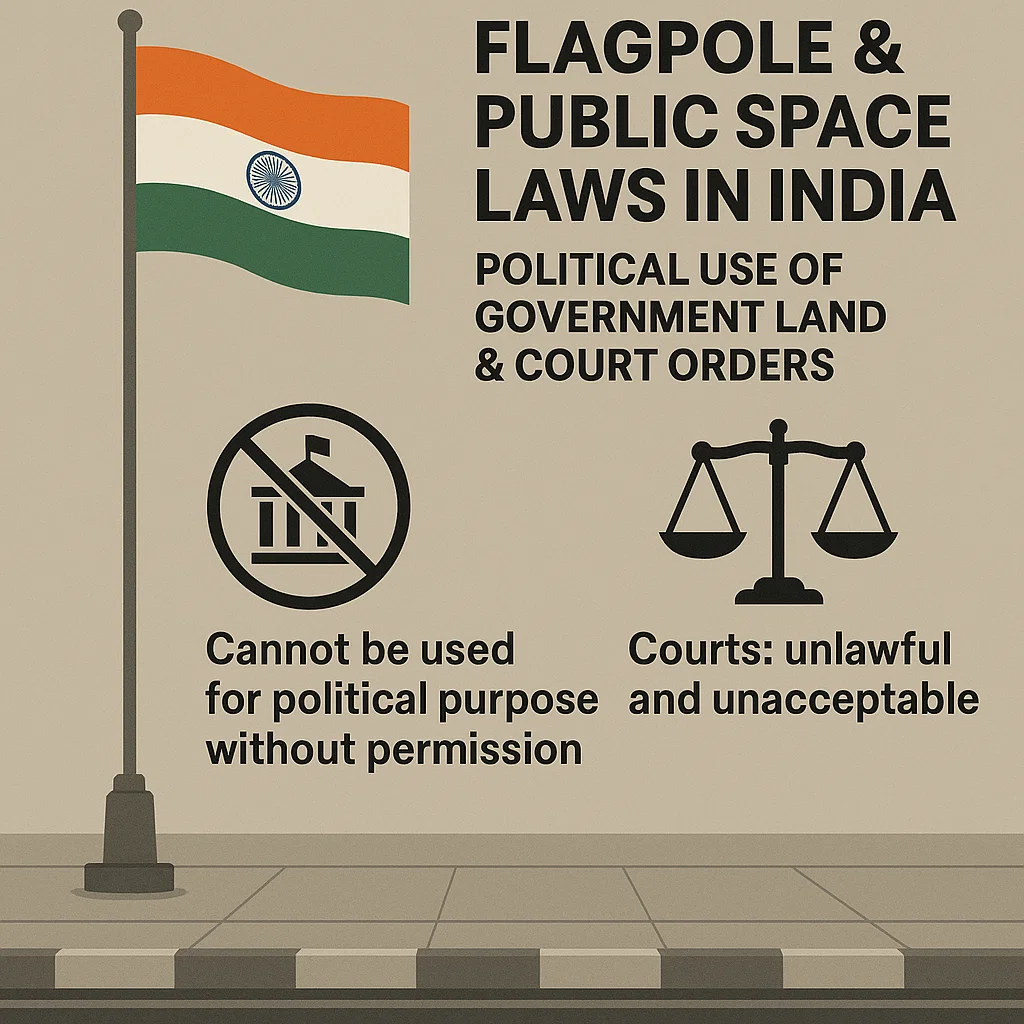
Flagpole & Public Space Laws in India: Political Use of Government Land & Court Orders
Public spaces such as roads, sidewalks, parks, and other government-owned land are designed to serve the community by providing safe, accessible, and shared environments for everyday activities. These areas are essential for the smooth functioning of urban life, enabling free movement of people and vehicles, supporting recreational activities, and contributing to the overall wellbeing of citizens. However, in many parts of India, these public spaces have increasingly become sites for political displays, most notably through the unauthorized installation of flagpoles, banners, and hoardings by various political parties and organizations.
The erection of flagpoles in public spaces, especially without proper permissions, has become a widespread issue. These flagpoles often remain as permanent fixtures, obstructing pedestrian pathways, disturbing traffic flow, and sometimes posing safety hazards during emergencies. This misuse of government land for political purposes disrupts the intended public use of these spaces and raises questions about governance, legality, and the balance between political expression and civic rights.
Over time, this issue has drawn the attention of the judiciary, which has issued several directives aimed at regulating the use of public spaces and preventing their unlawful occupation for political gains. Courts have recognized the importance of maintaining public order and ensuring that public property is preserved for the benefit of all citizens, rather than being monopolized for political symbolism or party propaganda.
Understanding the legal framework and judicial outlook on the political use of government land, particularly in the context of flagpoles and other symbols, is crucial not only for policymakers and legal professionals but also for everyday citizens. This knowledge helps promote awareness about the rights and duties related to public spaces, the limits of political expression in these areas, and the importance of respecting laws designed to protect shared urban environments.
BACKGROUND AND SIGNIFICANCE OF PUBLIC SPACE PROTECTION
Public spaces including roads, pavements, parks, and other government land serve diverse communal purposes: walking, commuting, markets, or resting. These spaces belong to every citizen, regardless of political affiliation, and are protected by the principle that the government must manage them fairly for everyone’s benefit.
The public trust doctrine, rooted in environmental jurisprudence, holds that certain resources like air, rivers, and public land are sacred and must remain accessible to all. Though originally applied to natural resources, this doctrine’s spirit extends to urban and civic space as well: the state cannot use public land for private or selective symbolic purposes without democratic justification or legal process.
When flagpoles are erected permanently on pavements or medians without permission, they qualify as encroachments. They occupy space, endanger pedestrian safety, interfere with traffic visibility, and often reflect political bias over civic neutrality. Recognizing this, courts have begun enforcing the law strictly to maintain public order and shared values.
Political Use of Government Land and Court Orders
Nature and Scope of Political Use of Government Land
Government land is broadly categorized as public land that is owned, maintained, and regulated by government authorities. This includes land used for roads, parks, government buildings, traffic junctions, footpaths, and vacant plots within urban and rural areas. These spaces are intended to serve the public interest by providing safe and accessible areas for transit, recreation, and social interaction.Political parties and leaders often seek to display their presence and promote their ideologies through the placement of flags, banners, and hoardings in these spaces. While political expression is a fundamental right guaranteed under the Constitution of India, it is subject to reasonable restrictions to ensure that it does not encroach upon public rights or cause disorder.The installation of political symbols on government land usually involves the erection of flagpoles or display boards. In many instances, these are installed without obtaining official permission, and their locations may obstruct pedestrian pathways, reduce road visibility, cause traffic congestion, or pose hazards during adverse weather or emergencies. The political use of government land thus creates a conflict between the freedom of political expression and the need to maintain public order and safety.
Legal and Constitutional Framework
The Constitution of India guarantees the right to freedom of speech and expression under Article 19(1)(a). However, this right is not absolute and can be restricted in the interest of public order, decency, morality, and sovereignty of the country, as mentioned in Article 19(2).
Government land is subject to various laws and regulations that govern its use, such as municipal laws, land encroachment laws, and traffic rules. Local municipal bodies and state authorities have the power to regulate, permit, or prohibit any activity on public land to safeguard public interest.Political use of government land without authorization is generally considered an illegal encroachment or misuse of public property. The government has the legal authority to remove unauthorized structures, including political flags and hoardings, to restore public order.
Court Orders and Judicial Intervention
Judicial intervention in regulating the political use of government land has been critical in upholding the rule of law and ensuring that political expression does not infringe on public rights. Courts have repeatedly issued orders directing authorities to remove illegal flagpoles and banners and maintain public spaces free of unauthorized encroachments.One of the key roles played by courts is balancing the competing interests of political freedom and public welfare. Several judgments have emphasized that while political parties have the right to express their views, this right cannot come at the cost of public safety, inconvenience, or violation of laws.
For example, courts have ruled that flagpoles or banners that obstruct pedestrian movement, reduce road safety, or cause environmental pollution must be removed regardless of the political significance attached to them. The judiciary has also instructed municipal authorities to enforce regulations strictly and ensure that any installation of political symbols on government land complies with existing laws and permissions.
Challenges Faced by Authorities
Municipal bodies and local governments face practical challenges in enforcing laws related to the political use of government land. Political influence often complicates enforcement, as ruling parties or influential leaders may pressure authorities to allow or overlook unauthorized installations.Furthermore, the proliferation of political symbols, especially during election periods or political rallies, makes it difficult for authorities to regulate or remove them promptly. There is also the challenge of balancing political sensitivities with administrative responsibilities, as removal of political symbols can lead to protests or political backlash.The lack of clear and uniform guidelines across states regarding permissions, sizes, and locations for political displays further complicates regulation efforts. This results in inconsistencies and confusion among political parties and authorities alike.
Recent Developments and Government Initiatives
Recognizing the growing concerns about misuse of public spaces, several state governments and municipal authorities have introduced guidelines and action plans to regulate political use of government land.Some cities have introduced designated zones or specific locations where political parties can display their flags and banners legally and safely. Others have mandated prior permissions and strict time limits for such displays, especially around election seasons.Technology and surveillance have also been employed to monitor unauthorized installations, and fines or penalties have been imposed on violators. Awareness campaigns encourage political parties to respect public spaces and comply with laws, promoting responsible political expression.
Practical Implications for Citizens
For citizens, the unrestricted political use of government land can create everyday inconveniences such as blocked sidewalks, traffic delays, and unsafe environments. It can also lead to an unhealthy urban landscape cluttered with political symbols that may polarize communities or create visual pollution.
Awareness of laws related to the use of public spaces empowers citizens to report illegal encroachments and demand action from local authorities. It also fosters civic responsibility and the understanding that political rights come with the duty to respect shared spaces.
Balancing Political Freedom and Public Interest
The core issue in political use of government land is finding the right balance between protecting the fundamental right of political expression and safeguarding the collective interest of society in using public spaces fairly and safely.Judicial rulings have consistently highlighted that political speech and symbolism should not infringe upon public order or safety. Reasonable restrictions on the manner, timing, and location of political displays are necessary and justified to prevent misuse.Authorities must adopt transparent, fair, and consistent regulations that allow political expression while protecting public rights. Political parties, in turn, must exercise restraint and responsibility in utilizing government land, respecting legal boundaries and the needs of the public.
JUDICIAL INTERVENTIONS AND IMPORTANT CASE RULINGS
1. A. Radhakrishnan v. State of Tamil Nadu (2019)
Court: Madras High Court
Bench: Justice S. Manikumar and Justice Subramonium Prasad
Citation: Decided on April 11, 2019
Facts:
A public interest litigation (PIL) was filed raising concerns about political parties and other organizations erecting flagpoles across Tamil Nadu without any prior permission. These flagpoles were being placed on road medians, footpaths, and other public places, posing a danger to pedestrians and motorists. Most of these installations were permanent structures, often with concrete bases, and remained even after the political or religious events were over.
Decision:
The court ruled that erecting permanent flagpoles on public property without proper permission amounts to encroachment. It directed all district collectors and municipal authorities to identify and remove unauthorized flagpoles. It was also clarified that action should be taken regardless of the political affiliations of the individuals or organizations involved. The court emphasized the duty of the state to maintain public safety and preserve public land for civic use, not political display.
2. Justice G.K. Ilanthiraiyan Order – January 27, 2025
Court: Madras High Court (Madurai Bench)
Bench: Justice G.K. Ilanthiraiyan
Citation: W.P.(MD) Nos. 29035, 29217 & 30354 of 2024
Facts:
A series of writ petitions were filed against illegal permanent flagpoles erected by political parties. The petitioners argued that such structures violated the citizens' right to free movement and endangered public safety. Authorities had failed to remove these despite clear legal guidelines.
Decision:
Justice Ilanthiraiyan passed a landmark order directing that all permanent flagpoles installed on public roads, footpaths, junctions, or public lands without valid permissions must be removed within three months. Temporary flagpoles were permitted only with prior approval and should be removed immediately after the event. Moreover, if the parties failed to comply, the local authorities were empowered to remove the poles and recover the costs from the responsible organizations. This judgment laid down a strict timeline for compliance and put responsibility squarely on the administration to act.
3. Political Parties v. State of Tamil Nadu (Appeal) – March 7, 2025
Court: Division Bench, Madras High Court (Madurai Bench)
Bench: Justice J. Nisha Banu and Justice S. Srimathy
Citation: Appeal against W.P.(MD) Nos. 29035, 29217 & 30354 of 2024
Facts:
Following the January 2025 order, various political parties challenged the decision, stating that flagpoles were symbolic expressions and had historical and cultural significance. They argued that removing all structures would violate their freedom of expression and that many flagpoles were installed with verbal permission from local representatives.
Decision:
The division bench rejected the appeal, upholding the single-judge order. It emphasized that while the freedom of expression is protected, it cannot override the rights of the public to safe and unobstructed access to roads and public spaces. The court found that no written permission was produced for many of the flagpoles and held that public property cannot be privatized for symbolic or political display.
4. Full Bench Order – July 2025 (Status Quo Order)
Court: Madras High Court (Full Bench)
Bench: Justices S.M. Subramaniam, R. Vijayakumar, and S. Sounthar
Citation: Reference made in response to conflicting interpretations of removal orders
Facts:
In light of the appeal decisions and growing public interest, a full bench was constituted to determine the broader legal and constitutional implications of banning flagpoles. Political organizations claimed their right to install flags under Article 19(1)(a) of the Constitution, whereas the state upheld the need for regulation of public spaces.
Decision:
The full bench issued a status quo order, meaning no further action (removal or installation) could be taken until the final decision. However, it made it clear that existing illegal flagpoles did not gain legality merely due to the stay. It directed the government to file a detailed affidavit outlining the current status of enforcement and future plans. The full bench reserved its final decision while protecting both public and political interests temporarily.
5. Kerala High Court – K.S. Sugunan v. State of Kerala (2021)
Court: Kerala High Court
Bench: Justice Devan Ramachandran
Citation: W.P. (C) No. 23465 of 2021
Facts:
A PIL was filed against political parties that had erected flagpoles along roads, footpaths, and pedestrian railings in Kerala. These installations were permanent, unregulated, and posed serious traffic hazards and civic inconvenience.
Decision:
The court declared that no flagpole may be erected on public roads, pedestrian railings, or footpaths without specific permission from the local authorities. It directed the state to audit all existing installations, frame rules for the removal of illegal poles, and penalize repeat offenders. It also reminded government departments that they are not above the law and must treat all political parties equally. This judgment reinforced the constitutional responsibility of the state to protect public spaces.
6. Kerala High Court – Further Orders on Flagpole Regulation (2025)
Court: Kerala High Court
Bench: Justice Devan Ramachandran
Citation: February 2025, continuation of W.P. (C) No. 23465 of 2021
Facts:
Despite the 2021 ruling, the court found that new flagpoles were still being erected without permission. Local authorities failed to implement the previous orders effectively. The issue came up for continued hearing.
Decision:
The court prohibited any further installations of flagpoles—whether temporary or permanent—on public lands until a comprehensive state policy was introduced. The court gave a six-month deadline to the government to finalize this policy and directed the police to support civic bodies in enforcement. It further warned that non-compliance would invite contempt proceedings.
PRACTICAL IMPLICATIONS FOR COMMUNITIES AND ORGANIZATIONS
Citizens, political groups, community organizations, and civic authorities must understand the practical outcomes of these legal developments:
Anyone planning to erect a flag in a public area—roadside, junction, park—must seek permission from municipal or relevant authorities in advance.
Successful applicants can install temporary flagpoles only for permitted durations, after which the site must be restored.
Unauthorized installations risk immediate removal and possible cost recovery from the responsible party.
Private land adjacent to public land may still pose liability if installations impede the public right-of-way or cross onto shared territory.
Municipal corporations must audit public spaces regularly to detect and correct encroachments; failure to do so may invite judicial criticism or direction.
Citizens can report flagpole encroachments through civic hotlines, ensuring safety and compliance are maintained.
For small community groups or festivals, proper coordination prevents inadvertent violation of public laws. They can still express identity, but within set rules and respect for equally shared public resources.
BENEFITS AND CHALLENGES
Benefits
Ensures safe, accessible public infrastructure for all: pedestrians, cyclists, motorists.
Affirms equality no flagpole privileges for one political group over others.
Enhances civic harmony by reducing disputes over public property.
Upholds the rule of law without suppressing legitimate expression.
Challenges
Enforcement may provoke political backlash or tensions, especially around election seasons.
Administrative logistics for auditing and removal can be resource-intensive.
Temporary permissions may become politicized, with delays or refusals causing controversy.
Courts face delicate tasks in balancing freedom of expression with civic order.
Nevertheless, open dialogue between civic agencies, political groups, and community leaders can smooth transitions and reduce conflict.
CONCLUSION
India’s complex social fabric includes powerful symbols—flags being among the most potent. Yet, democracy is not served by symbols that overshadow civic responsibility. Courts across the country have gradually clarified that public spaces are community assets, not extensions of political headquarters. Legal interventions reinforce that expression must be balanced with shared rights and safety.
Ongoing developments in Tamil Nadu, Kerala, and beyond reflect a broader commitment: uphold democratic expression, yes—but within the framework of civic order and the rule of law. As India continues to urbanize and express its identity dynamically, ensuring that public spaces continue to serve everyone is essential for democratic maturity.
By engaging with authorities respectfully, seeking permission, and removing installations post-use, political and social organizations can preserve democratic voice while honoring shared civic values. In turn, citizens will enjoy safer, open, and accessible public spaces, free from obstructions, and governed by fairness.
SOURCES
Supreme Court of India Judgments on Public Space and Political Expression
The Constitution of India – Articles 19(1)(a) and 19(2) (Freedom of Speech and Reasonable Restrictions)
Municipal Corporation Acts and Local Government Rules of Various States
Land Encroachment Laws and Urban Land Use Regulations in India
Legal Commentary and Analysis by the Centre for Policy Research (CPR), New Delhi
Reports and Publications by the Ministry of Housing and Urban Affairs, Government of India
Research Papers on Urban Governance and Public Space Management in Indian Cities
Law Commission of India Reports on Encroachment and Public Land Use
Academic Journals such as the Indian Journal of Public Administration
Books on Constitutional Law and Urban Development in India by Legal Experts like Dr. Upendra Baxi and Prof. M.P. Jain