
- Blog
- |
- 16 Oct 2025
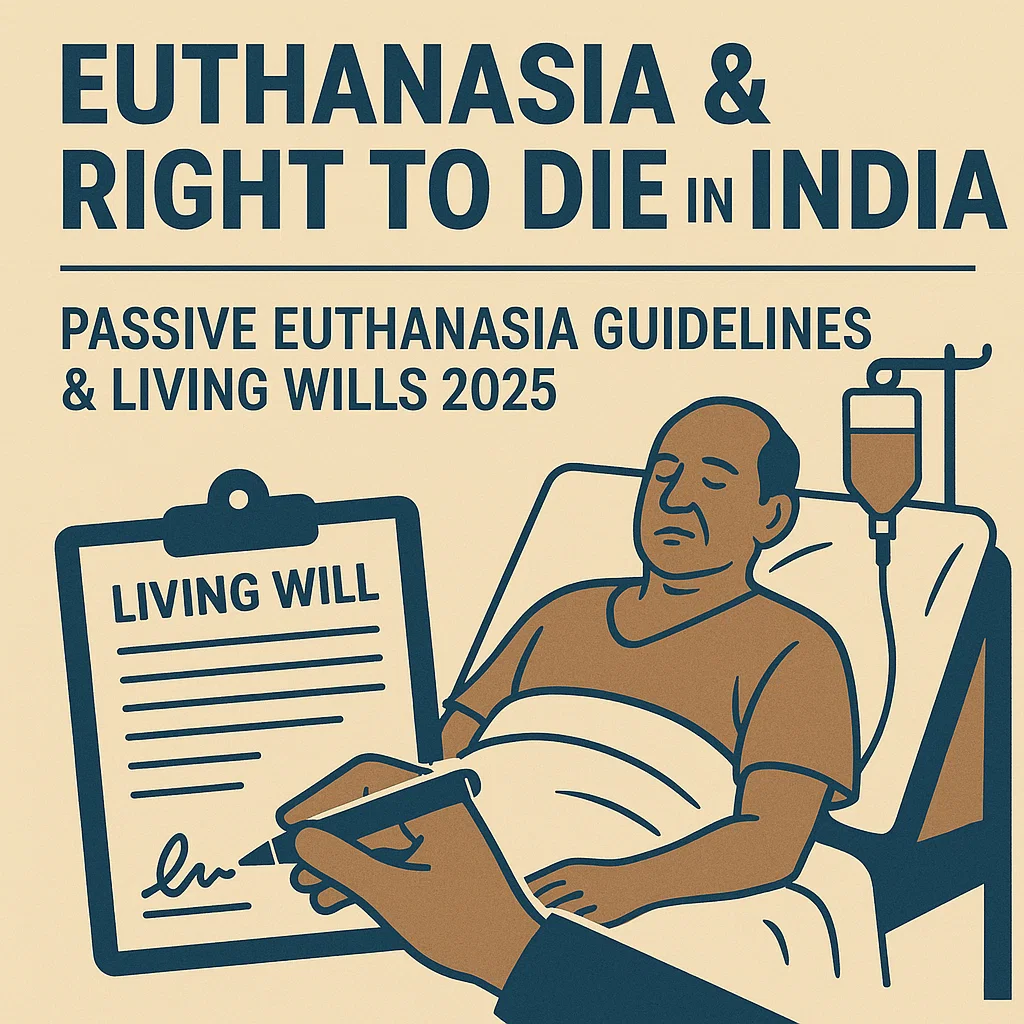
Euthanasia & Right to Die in India: Passive Euthanasia Guidelines & Living Wills 2025
The concept of euthanasia, or the right to die with dignity, has been a subject of intense debate worldwide, involving ethical, medical, and legal considerations. Euthanasia can be broadly classified into active and passive forms. While active euthanasia involves directly causing the death of a patient to relieve suffering, passive euthanasia refers to withholding or withdrawing medical treatment that only prolongs the process of dying.
In India, the legal journey towards recognizing the right to die with dignity, especially passive euthanasia, has evolved gradually through judicial intervention. For many years, the law neither clearly permitted nor prohibited euthanasia, leaving patients and their families in a state of uncertainty. The Supreme Court of India has played a pivotal role in shaping the legal framework, emphasizing the importance of personal autonomy and dignity at the end of life.
The question of euthanasia, or the right to die with dignity, has been a sensitive and complex issue worldwide, involving deep ethical, medical, and legal considerations. Euthanasia generally refers to the practice of intentionally ending a person’s life to relieve suffering caused by incurable or terminal illness. It is broadly divided into two types: active euthanasia, where deliberate action is taken to cause death, and passive euthanasia, where life-sustaining treatment is withheld or withdrawn, allowing the patient to die naturally.
In India, the subject of euthanasia remained legally ambiguous for many years. The Indian legal system did not explicitly recognize the right to die, and the absence of clear laws meant patients in terminal conditions, their families, and medical practitioners often faced uncertainty and distress over end-of-life decisions. Traditional societal and cultural values, combined with legal prohibitions on suicide and homicide, complicated the acceptance of euthanasia.
However, recognizing the importance of human dignity and individual autonomy, the Supreme Court of India has progressively shaped the legal stance on passive euthanasia through landmark judgments. These rulings affirm that the right to life under Article 21 of the Indian Constitution also includes the right to die with dignity, particularly in cases where medical treatment only prolongs suffering without hope of recovery.
The legal recognition of passive euthanasia in India marks a significant shift toward respecting patients’ autonomy, allowing them to refuse extraordinary medical interventions when faced with terminal illness or irreversible conditions. It also introduced the concept of advance medical directives or “living wills,” empowering individuals to make informed decisions about their treatment in advance.
IMPLIFICATION OF LIVING WILL PROCEDURES
A living will, also known as an advance medical directive, is a legal document that allows an individual to specify their preferences regarding medical treatment in situations where they might become incapacitated and unable to communicate their wishes. It primarily covers decisions about life-sustaining treatment, such as mechanical ventilation, feeding tubes, and other interventions that may prolong life artificially. The concept is essential in ensuring that patients maintain autonomy over their bodies and medical care even when they lose the ability to make decisions.
In India, the Supreme Court’s 2018 judgment in the Common Cause vs. Union of India case was a groundbreaking step that legalized the use of living wills for passive euthanasia. The Court recognized that living wills give individuals the right to refuse medical treatment and to die with dignity, especially in terminal or irreversible conditions. However, the process prescribed by the Court at that time was complicated and procedural-heavy, which made it difficult for many patients and families to implement living wills effectively.
Initially, the 2018 guidelines required the living will to be notarized and attested by a judicial magistrate before being accepted by medical authorities. This added an extra layer of complexity and made the process less accessible, especially for people in rural or remote areas where magistrates and notaries may not be easily available. The involvement of judicial magistrates also led to delays, which could be crucial in end-of-life situations where timely decisions are essential.Recognizing these practical difficulties, the Supreme Court revisited and revised its guidelines in 2023 to simplify the procedure for creating and implementing living wills. The Court relaxed the requirement of magistrate attestation and allowed living wills to be attested by a notary or a gazetted officer, such as a government official authorized to certify documents. This change made the process more accessible, affordable, and less time-consuming for patients and their families.Additionally, the Supreme Court integrated living wills into the National Health Digital Record (NHDR) system. This integration allows living wills to be stored digitally in a secure and standardized format that can be accessed nationwide by authorized medical practitioners. The digital registry ensures that the patient’s preferences are easily retrievable in emergencies or when the patient is admitted to any hospital, regardless of location. This step is critical to avoiding confusion or conflicts regarding the patient’s wishes during critical medical decisions.
The simplified procedure also included clear protocols for doctors and hospitals regarding how to handle living wills. Medical practitioners are now required to verify the authenticity of the living will, consult with a medical board, and follow due process before withdrawing or withholding life-sustaining treatment. These safeguards help balance the respect for patient autonomy with the need to prevent misuse or coercion.
Moreover, the Court emphasized the importance of creating awareness about living wills among the public, medical professionals, and legal experts. There remains a general lack of knowledge about the existence and validity of living wills in India. The Court recommended that government and healthcare institutions conduct awareness programs and training to ensure that patients and doctors are well informed about the right to create living wills and the procedures involved.
Despite these improvements, challenges persist. Cultural attitudes toward death and medical decision-making can make it difficult for individuals to discuss or formalize end-of-life wishes. There is also the ongoing need for robust legal frameworks to provide clarity and uniformity in how living wills are treated across different states and healthcare institutions.
Union Health Ministry's Draft Guidelines (2024)
In the evolving landscape of end-of-life care in India, one of the most important recent developments is the introduction of draft guidelines by the Union Health Ministry in 2024 regarding passive euthanasia. These guidelines were formulated in response to the Supreme Court’s judgments and the growing demand for standardized procedures in handling terminally ill patients who may choose to withdraw life support or refuse extraordinary medical intervention.
The 2024 draft guidelines aim to offer a uniform and ethical framework for healthcare professionals and institutions, ensuring clarity in medical decision-making, legal compliance, and the protection of patient rights. They provide detailed procedures for when and how life support can be lawfully withdrawn or withheld, and under what conditions medical professionals are protected from legal liability.
Key Features of the Draft Guidelines
Conditions for Withdrawing Life Support
The guidelines define clear criteria for when passive euthanasia may be considered. These include:Brainstem death as certified by a team of medical experts, following the protocol used for organ donation.
Terminal illness where no curative treatment exists and where further intervention would only prolong suffering without meaningful recovery.
Irreversible coma or vegetative state with no chance of regaining consciousness.
Informed refusal of treatment by a patient with full mental capacity or by a legally recognized surrogate (such as next of kin) in cases where the patient is incapacitated.
Role of Medical Boards
The guidelines mandate that decisions on passive euthanasia must be made by a multi-disciplinary medical board consisting of:The treating physician,
A hospital-appointed specialist in critical care or internal medicine,
A psychiatrist or neurologist (if required), and
An external, independent expert in the relevant field.
The board is required to examine the patient thoroughly and come to a unanimous decision that withdrawal of treatment is in line with ethical and medical standards.
Documentation and Transparency
All decisions, medical evaluations, and consents must be carefully documented. This includes:A written report by the medical board explaining their decision.
A signed consent form from the patient (if competent) or the legal surrogate.
Medical records showing the patient’s condition and prognosis.
A hospital ethics committee's approval where available.
This transparent documentation process is designed to avoid any future legal or ethical disputes.
Respect for Living Wills
The draft guidelines also emphasize the role of advance directives or living wills. Hospitals are instructed to honor valid living wills once their authenticity is verified, and to initiate the process of life-support withdrawal accordingly, after medical board approval. The integration of living wills into national health records (as per Supreme Court orders) further strengthens their legal enforceability.
Broader Impact of the Guidelines
These draft guidelines represent a major step toward standardizing and humanizing end-of-life care in India. They aim to prevent unnecessary suffering in terminally ill patients while ensuring medical, ethical, and legal safeguards are in place. By doing so, the Ministry seeks to reduce confusion among hospitals and families and bring uniformity across the country in how such cases are handled.
Moreover, they reflect a shift in public policy — one that accepts death as a natural part of life and respects a person’s autonomy in choosing how they wish to approach it. By setting detailed rules and institutional responsibilities, the guidelines attempt to balance the right to die with dignity with the obligation of the state to protect life and prevent misuse.
Though still in draft form (as of 2025), these guidelines are expected to be finalized soon and incorporated into national health protocols. They are likely to form the backbone of future legislation, making the legal and medical handling of passive euthanasia more humane, structured, and respectful of patients’ wishes.
Ethical and Legal Challenges
While the recognition of passive euthanasia and the right to die with dignity has been a progressive step for India’s legal and healthcare systems, it is not without its share of complex ethical and legal challenges. These challenges arise from the sensitive nature of end-of-life decisions, cultural values, lack of awareness, implementation gaps, and the potential for misuse. Understanding these issues is crucial to ensuring that the laws and guidelines are applied fairly, ethically, and effectively.
Ethical Concerns
Sanctity of Life vs. Right to Die
One of the most prominent ethical debates around euthanasia is the conflict between the sanctity of life and an individual’s autonomy to die with dignity. Many religious and cultural traditions in India regard life as sacred and believe that taking any action to end life even passively is morally wrong. These views often influence public opinion and even the attitudes of healthcare professionals.
On the other hand, there is the ethical argument that allowing a person to suffer needlessly in a terminal or vegetative state is a denial of human dignity. Advocates for passive euthanasia argue that every individual should have the right to decide when and how they wish to end their suffering, especially when medical science offers no chance of recovery.
Fear of Misuse
A major ethical and legal concern is the potential misuse of euthanasia laws, particularly by family members, healthcare providers, or institutions for financial or personal gain. In a country like India, where issues like property disputes, elder neglect, and economic pressures are not uncommon, critics fear that vulnerable patients may be pressured into or denied treatment under the guise of passive euthanasia.
To prevent this, the Supreme Court and the Health Ministry have introduced detailed procedural safeguards. However, critics argue that these may still not be sufficient in poorly regulated private healthcare systems or in rural areas with limited oversight.
Competence and Consent
Determining a patient’s mental competence to make an end-of-life decision is another ethical issue. There may be doubts about whether a person is in the right frame of mind when drafting a living will or deciding to refuse treatment. Additionally, what happens when a patient has not made a living will, and family members disagree on whether to continue life support?
These situations create emotionally and ethically charged environments where doctors are often caught between legal requirements, medical ethics, and the wishes of the family.
Legal Challenges
Lack of Awareness and Accessibility
Despite the 2018 and 2023 Supreme Court rulings, public awareness of living wills and passive euthanasia remains low. Many people do not know they have the legal right to draft a living will or are unsure about the process. This lack of awareness also extends to healthcare providers, especially in smaller hospitals or rural settings where the concept is rarely discussed.This knowledge gap can result in unnecessary prolongation of suffering, denial of patient autonomy, or inconsistent application of the law.Implementation Gaps
Even though the legal framework exists, the implementation of the guidelines is uneven across states and institutions. Some hospitals have ethics committees and trained personnel, while others lack both the infrastructure and the policy framework to handle passive euthanasia cases. This inconsistency creates inequality in how end-of-life care is provided and undermines the uniformity of the right to die with dignity.Legal Recognition of Digital Wills
The 2023 changes by the Supreme Court that allowed for digital storage of living wills were a step forward. However, this raises questions about data privacy, consent verification, and technological access, especially in under-resourced areas. How digital living wills will be authenticated and whether they will be honored uniformly remains a legal grey area.Absence of Comprehensive Legislation
Though the Supreme Court’s judgments are binding, India still lacks a comprehensive legislative framework governing passive euthanasia and living wills. The current system relies heavily on judicial guidelines and draft health ministry rules. Without codification into a parliamentary act, there remains uncertainty and room for legal challenges in complex or disputed cases.Criminal Law Provisions
The Indian Penal Code (IPC) still contains provisions that may potentially conflict with passive euthanasia. For example:Section 309 criminalizes attempted suicide (though largely defunct now).
Section 306 addresses abetment of suicide.
Section 300 of IPC, on culpable homicide, could technically be interpreted to criminalize some end-of-life decisions.
Until these provisions are harmonized with euthanasia guidelines, medical professionals may act with caution, fearing criminal liability despite judicial protections.
Landmark Supreme Court Cases on Euthanasia in India.
Aruna Shanbaug v. Union of India (2011)
Facts of the Case:
Aruna Shanbaug was a nurse working at King Edward Memorial Hospital in Mumbai. In 1973, she was brutally assaulted and strangled with a dog chain by a ward boy, resulting in severe brain damage and a vegetative state. She remained in that condition for over 40 years. In 2011, journalist Pinki Virani filed a petition in the Supreme Court seeking permission for the withdrawal of Aruna’s life support, arguing that continued existence in a vegetative state violated her right to dignity.
Judgment:
The Supreme Court rejected the plea for active euthanasia in Aruna’s case but allowed for passive euthanasia under strict guidelines. It recognized that withdrawing life support could be morally and legally different from actively ending a person’s life. The Court laid down the requirement of approval by a high court and medical board before passive euthanasia could be allowed, stating that such decisions must be guided by the best interests of the patient.
Impact:
This judgment was the first legal recognition of passive euthanasia in India, although it imposed a highly regulated framework. It sparked nationwide debate on the need for a more accessible and humane legal process for end-of-life decisions.
2. Common Cause v. Union of India (2018)
Facts of the Case:
The NGO “Common Cause” filed a Public Interest Litigation (PIL) seeking the right to die with dignity and the legal acceptance of living wills and advance medical directives. The petition argued that a person should have the right to refuse medical treatment or life support in cases of terminal illness or irreversible conditions.
Judgment:
The five-judge Constitution Bench of the Supreme Court unanimously held that the right to die with dignity is a fundamental right under Article 21 of the Constitution. The Court formally legalized passive euthanasia and recognized the validity of living wills. It laid down detailed procedures, including:
How a person may execute a living will.
The composition and responsibilities of medical boards.
The role of judicial magistrates in authorizing the withdrawal of treatment.
Impact:
This ruling was historic and progressive. It empowered individuals with the right to decide their own medical fate, protected patients from forced treatment, and gave legal status to advance medical directives. However, the procedure prescribed was quite complex and difficult to implement in emergency situations.
3. Common Cause Guidelines Simplification (Supreme Court Judgment, 2023)
Facts of the Case:
Due to practical challenges in implementing the 2018 ruling, a request was made to simplify the process of executing living wills and applying passive euthanasia. The 2018 judgment had unintentionally created procedural bottlenecks due to its requirement for the attestation of living wills by judicial magistrates and multiple layers of medical and legal approvals.
Judgment:
In January 2023, a Supreme Court Bench modified the earlier guidelines and simplified the process. The key changes included:
Allowing attestation of living wills by notaries or gazetted officers, instead of judicial magistrates.
Enabling living wills to be stored in digital health records under the National Health Digital Mission.
Clarifying the role of medical boards and reducing bureaucratic delays in decision-making.
Impact:
This judgment made it easier for individuals to create and implement living wills, enhancing the practical utility of passive euthanasia as a legal right. It also strengthened the integration of euthanasia laws with the evolving healthcare digital ecosystem in India.
Sources
Supreme Court Judgments
Aruna Ramachandra Shanbaug v. Union of India, (2011) 4 SCC 454
Common Cause (A Regd. Society) v. Union of India, (2018) 5 SCC 1
Common Cause v. Union of India (2023, Revised Guidelines on Living Wills) — Supreme Court Bench Order
Constitution of India
Article 21: Protection of life and personal liberty – Interpreted by the Supreme Court to include the right to die with dignity.
Union Ministry of Health & Family Welfare (2024 Draft Guidelines)
Draft guidelines on the withdrawal of life support treatment in terminally ill patients.
Public consultation papers and health policy updates.
National Health Digital Mission (NHDM)
Integration of living wills into the National Health Digital Record system as per 2023 SC directions.
The Indian Penal Code, 1860 (IPC)
Section 309 (Attempt to commit suicide) – partially decriminalized.
Section 306 (Abetment of suicide)
Section 300 and 302 (Culpable homicide and murder)
Law Commission of India Reports
196th Report (2006): “Medical Treatment to Terminally Ill Patients (Protection of Patients and Medical Practitioners)” – Proposed legal framework for passive euthanasia and living wills.
Ethical Guidelines by the Indian Council of Medical Research (ICMR)
Guidelines for Do Not Resuscitate (DNR) and end-of-life care decisions.
Legal and Academic Journals
Journal of Indian Law and Society
NUJS Law Review
Indian Journal of Medical Ethics
Economic and Political Weekly (EPW) – Articles on euthanasia, medical ethics, and constitutional law.
Bar & Bench and LiveLaw
Legal news portals covering judgments, expert opinions, and policy developments on euthanasia.
Newspaper Reports (used for factual updates and quotes)
The Hindu
The Indian Express
Hindustan Times
India Today
Times of India