
- Blog
- |
- 16 Oct 2025
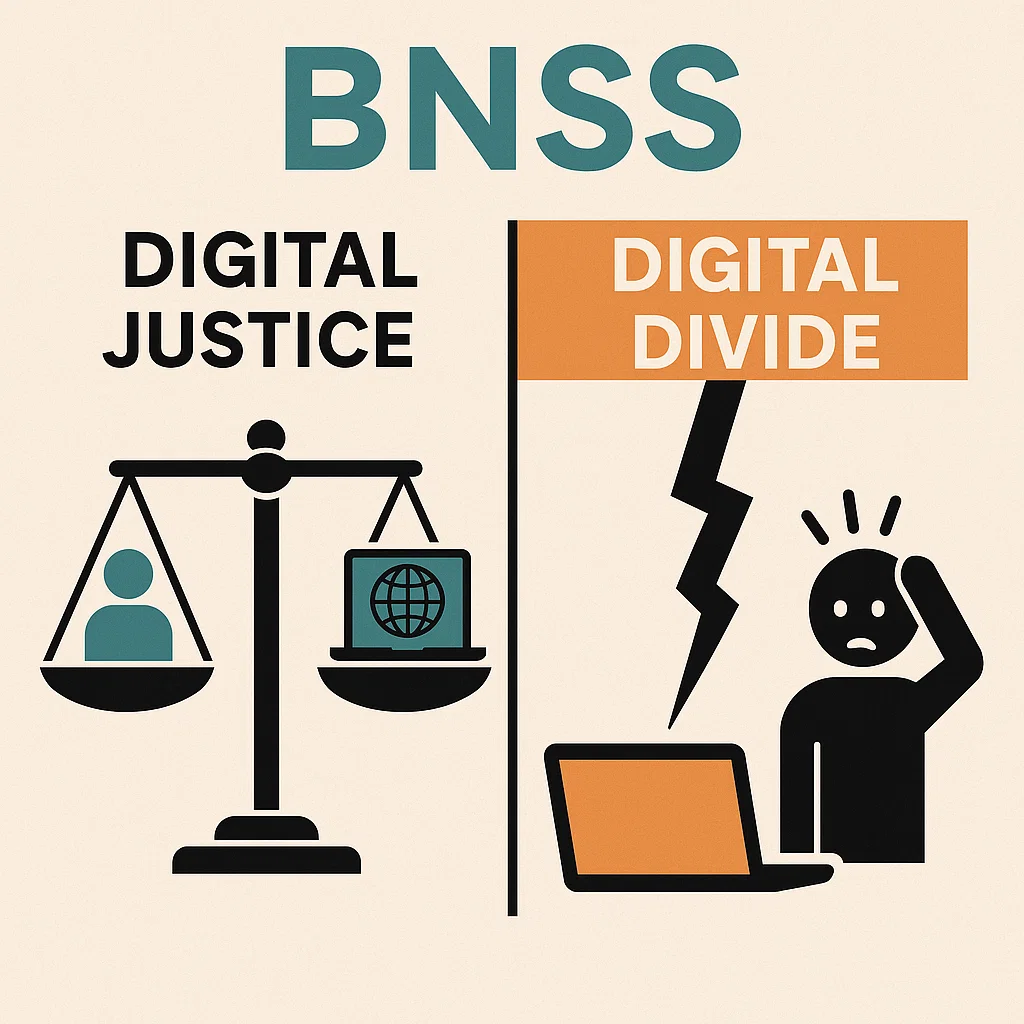
Digital Justice vs Digital Divide under BNSS
The digital revolution has swept across all sectors of modern society, transforming the way we communicate, work, learn, and even seek justice. In the 21st century, digitalization has become an inevitable force shaping governance, legal frameworks, and citizen rights. At the heart of this transformation lies a critical tension: while technology holds the power to make systems faster, more transparent, and more accessible, it also risks leaving behind those who lack the resources, skills, or infrastructure to participate fully. This dichotomy becomes especially important when examining the legal and criminal justice systems under India's newly introduced Bharatiya Nagarik Suraksha Sanhita (BNSS), 2023.
The BNSS, as a part of India’s broader criminal law reforms replacing the colonial-era Criminal Procedure Code (CrPC), has introduced several progressive provisions designed to modernize and digitize the criminal justice process. These include electronic communication of summons, digital filing of FIRs, audio-video recording of statements, use of forensic technology, and virtual trials. These reforms aim to enhance efficiency, reduce delays, and make the justice system more citizen-friendly. However, they also raise critical concerns about accessibility and equity in a digitally unequal society.
To understand the implications of these changes, we must examine two key concepts:
What is the Digital Divide?
The digital divide refers to the gap between individuals, households, or regions that have access to modern information and communication technologies and those that do not. In India, this divide is evident along several axes—urban vs. rural, rich vs. poor, male vs. female, literate vs. illiterate. It manifests in disparities in access to high-speed internet, smartphones, digital skills, and even basic electricity. This divide is not just about infrastructure; it is about opportunity, awareness, and capability.
In the justice system, the digital divide can have devastating consequences. If a person cannot access an e-court portal, file a digital complaint, or attend a virtual hearing due to lack of resources or knowledge, they may be effectively denied access to justice. Thus, any push toward digitalization in the justice sector must carefully consider the needs of the digitally marginalized.
What is Digital Justice?
In contrast, the concept of digital justice emerges as a response to this inequality. Digital justice envisions a world where technology is used not merely for efficiency, but to expand access, promote fairness, and empower all citizens, regardless of their background or location. It is about ensuring that the benefits of digital reforms reach every corner of society and that technology is a tool of inclusion rather than exclusion.
Digital justice means creating platforms that are accessible to people with disabilities, available in multiple languages, and usable even by those with limited literacy. It involves building systems that prioritize transparency, accountability, and citizen participation. In the context of the BNSS, it means making sure that the new digital procedures introduced under the law do not widen existing inequalities but instead serve as bridges toward greater justice.
Why This Debate Matters Now
The debate between digital justice and the digital divide has never been more relevant than in today’s India. With over 900 million internet users but still hundreds of millions without reliable connectivity or digital literacy, the country stands at a crossroads. As the BNSS aims to usher in a new era of technology driven legal processes, the challenge is to ensure that these reforms are not just efficient but also inclusive.
This blog explores this critical intersection. How does the BNSS deal with the realities of India’s digital divide? Can its ambitious reforms truly bring digital justice to all? Or will they end up reinforcing the very barriers they aim to dismantle? By dissecting these questions, we hope to gain a clearer understanding of the path forward—one that combines technological advancement with social equity, and legal modernization with democratic access.
Digital Justice as a Response
In the face of rising digital inequality, digital justice is not just a lofty ideal—it is a necessary response to the challenges posed by the digital divide. As legal systems become increasingly reliant on technology, digital justice acts as a guiding principle to ensure that no citizen is left behind. It is about harnessing digital tools to deliver not only faster justice but fairer, more inclusive justice.
What Constitutes Digital Justice?
Digital justice extends beyond merely putting courtrooms online or enabling e filing of documents. It is a holistic concept that encompasses multiple layers of access, equity, empowerment, and transparency. Here are the key components:
1. Access to Technology:
At the most basic level, digital justice requires that all citizens have access to the necessary tools—smartphones, internet, and electricity. Without these, the promise of digital courts, virtual hearings, and online FIRs remains inaccessible to many.
2. Accessibility for All Abilities:
True digital justice ensures that platforms are usable by persons with disabilities—visual, auditory, cognitive, or motor-related. It means incorporating features like screen readers, sign language interpretation, easy navigation, and multi-language support.
3. Digital Literacy and Skills:
Access alone is not enough. Citizens must be educated and empowered to use digital tools confidently. This is particularly important for vulnerable groups such as the elderly, rural populations, and women in marginalized communities.
4. Transparency and Accountability:
Digital systems should not become opaque. Instead, they must increase the transparency of judicial processes, reduce discretion-based biases, and ensure decisions are well-documented and easy to understand. Public access to case statuses, judgments, and proceedings enhances trust in the system.
5. Equity and Fairness:
Digital platforms must be designed and implemented in ways that do not disproportionately benefit the privileged while sidelining the disadvantaged. Equity demands tailored support systems for different population segments.
Global and Indian Frameworks Promoting Digital Justice
Across the world, governments and institutions have recognized the imperative to bridge the digital divide through justice-centric digital innovation. A few important efforts include:
• UN Sustainable Development Goals (SDGs):
Goal 16 emphasizes “Peace, Justice and Strong Institutions”, calling for accessible justice for all. Digital justice aligns directly with this global mandate.
• United Nations High-Level Panel on Digital Cooperation (2019): Advocated for “leaving no one behind” in the digital age, emphasizing the need for digital public infrastructure that upholds human rights and inclusivity.
• OECD’s Principles on Access to Justice (2016):
Stressed that access to justice should adapt to modern technologies and meet the needs of diverse populations.
India’s Approach to Digital Justice
India has also taken steps to embed digital justice within its legal and governance reforms:
• e-Courts Mission Mode Project:
Launched in 2005 and still evolving, this project has digitized case records, enabled virtual courtrooms, and created online case management systems.
• National Judicial Data Grid (NJDG):
A searchable, real-time database that promotes transparency and allows citizens to track case progress.
• VIDEOCONFERENCING in courts (especially post-COVID-19): Widely adopted for hearings, bail pleas, and other proceedings, though accessibility remains uneven.
• Digital India Programme (2015):
A flagship initiative to transform India into a digitally empowered society and knowledge economy. It supports key justice-sector reforms through improved digital infrastructure.
• PM Grievance Redress Mechanism:
Encourages direct citizen engagement with government departments and seeks resolution through digital interfaces.
Despite these steps, many of these reforms remain urban-centric and inaccessible to the lowest economic or social strata. The push for digitalization without universal digital empowerment risks reinforcing existing inequities. That’s where digital justice, not just digital transformation, becomes essential.
Digital Justice: A Double-Edged Sword Without Inclusion
While digital tools can make justice delivery more transparent and efficient, they can also become gatekeepers. A person in a remote village who lacks a smartphone, reliable internet, or the skills to use an online legal aid portal is excluded from the very system designed to help them. Similarly, language
barriers—many portals are only in English or Hindi—further alienate regional or tribal populations.
Hence, digital justice must be seen not as a technological upgrade, but as a social commitment. It demands careful policymaking, inclusive design, and continuous outreach. It also requires the judiciary, government, civil society, and technologists to work collaboratively.
Challenges Posed by the Digital Divide under BNSS
Despite the progressive ambitions of the BNSS, the digital divide poses major challenges that may undermine its equitable rollout.
• Infrastructure Deficit: Many rural police stations and courts lack basic digital infrastructure—computers, reliable internet, e-courts, forensic labs—making electronic processes impractical in these areas.
• Overloaded Forensic Facilities: Section 176(3) mandates video-recorded forensic evidence collection, but state labs are often underfunded and already overburdened. Relying on neighboring states may cause procedural delays and coordination issues.
• Procedural Ambiguities: Some BNSS provisions, like FIR filing via digital means, lack clarity. For example, Section 173(1) does not specify procedures if the complainant fails to sign the digitally filed FIR within three days. Similarly, there's no guidance on language use for FIRs, which may disadvantage non-native speakers or those with low literacy.
• Lack of Training and Resistance to Change: Even where infrastructure exists, many police, judges, and court staff lack training in digital tools or are resistant to abandoning traditional methods.
• Empirical Concerns About New Tech: Issues such as possible misuse of AI, deepfakes during virtual trials, and lack of transparency in digital processes could erode trust or compromise justice.
While digital transformation promises efficiency, without addressing these challenges, BNSS risks entrenching existing inequities.
Achieving Digital Justice in the BNSS Era
To ensure that BNSS-induced digital reforms serve as bridges rather than barriers, targeted strategies are essential:
• Infrastructure Expansion
Invest in e-courtrooms, video-conferencing setups, reliable internet, and digital data storage—especially in remote and underserved areas.
• Upgrading Forensic Capacity
Strengthen forensic labs through funding, staff augmentation, and inter state collaborations to ensure video-recorded evidence collection stays timely and credible.
• Capacity Building and Sensitization
Implement comprehensive training programs for law enforcement, judiciary, and lawyers to familiarize them with BNSS provisions, electronic procedures, and rights-based approaches.
• Clear Operational Guidelines
Supplement BNSS with detailed standard operating procedures addressing concerns like FIR signing timelines, permissible languages, and handling digital summons, ensuring uniformity and procedural clarity.
• Inclusive Access for Marginalized Groups
Launch outreach initiatives—public legal aid centers, community kiosks, mobile assistance units—to help those without personal access navigate digital platforms.
• Safeguarding Privacy and Combating Misuse
Establish strict data protection, authentication, and audit mechanisms to
prevent misuse (such as deepfakes or unauthorized surveillance) during electronic proceedings.
• Monitoring and Feedback Loops
Create evaluation systems with civil society participation for ongoing assessment of BNSS implementation, capturing systemic gaps and adjusting strategies accordingly.
India’s Digital Inclusion Efforts: Facilitators for BNSS-Era Digital Justice
India has initiated several programs that can catalyze the equitable delivery of justice under BNSS:
• Digital India and Connectivity Expansion
Initiatives like BharatNet bring broadband to villages; Internet Saathi and PMGDISHA promote digital literacy—essential building blocks for accessing e-justice.
• Legal Aid and Public Access Points
Existing legal aid centers and Common Service Centres (CSCs) can be equipped and supported to assist citizens with filing e-FIRs or attending virtual hearings, bridging gaps in personal access.
• Cybercrime Units and Forensics
Strengthening cybercrime cells and digital forensics infrastructure will support BNSS's emphasis on electronic evidence and tech-infused investigations.
• Pilot Tech Innovations
Efforts such as city-level portals that send SMS updates to complainants demonstrate public-friendly digital integration in BNSS-aligned workflows.
Although these programs aren’t justice-specific, they create critical complementary support systems for digital justice to flourish.
Vision: Digital Justice Realized
Imagine a transformed justice landscape under a fully inclusive BNSS framework:
• E-FIRs accessible to all even remote or economically disadvantaged individuals can report crimes electronically without travel or gatekeeping.
• Virtual trials with safeguards legal proceedings conducted online, with measures like identification verification and witness protection, making justice more efficient and secure.
• Transparent evidence collection search and forensic procedures are recorded audiovisually, ensuring integrity, reducing tampering, and increasing trust.
• Equitable infrastructure well-equipped rural courts, e-courts, and digital kiosks ensure that geographic or socio-economic status doesn’t impede access.
• Empowered citizens and institutions digitally literate communities, coupled with trained legal officials, navigate the system confidently, promoting fairness and accountability.
• Adaptive and responsive systems continuous feedback, evaluation, civil society involvement, and tech audits keep the system evolving and responsive to challenges.
In such a scenario, digital justice is not an exception it’s the foundation of a fair, modernized, responsive legal system.
Conclusion
The BNSS heralds a vital transformation by embedding electronic procedures into India’s criminal justice system. Its potential to deliver faster, transparent, and technologically advanced justice is undeniable. But delivering on that promise hinges on bridging the digital divide and centering digital justice in implementation.
Key takeaways:
• Bridging the divide is critical: Without digital infrastructure, literacy, and inclusion, BNSS risks marginalizing precisely those it seeks to empower.
• Holistic implementation matters: Technology, policies, training, and civil society oversight must move in tandem to ensure fairness.
• Equity over efficiency: Digitalization should not merely optimize processes—it must ensure justice is accessible to all.
• Collective responsibility: Governments, judiciary, civil society, and technologists must collaborate to build a truly inclusive, resilient digital justice system under BNSS.