
- Blog
- |
- 16 Oct 2025
Bar Council Enrollment in India
In India, the legal profession holds a special place in the structure of democratic governance. Advocates not only represent clients in courts, but they also serve as protectors of justice, interpreters of the Constitution, and defenders of fundamental rights. But before one can officially step into this powerful role, there is a necessary legal and procedural step of enrollment with the Bar Council. This process is governed by the Advocates Act, 1961, which lays down who can be admitted as an advocate, how enrollment should be done, and what rights and duties come with it.
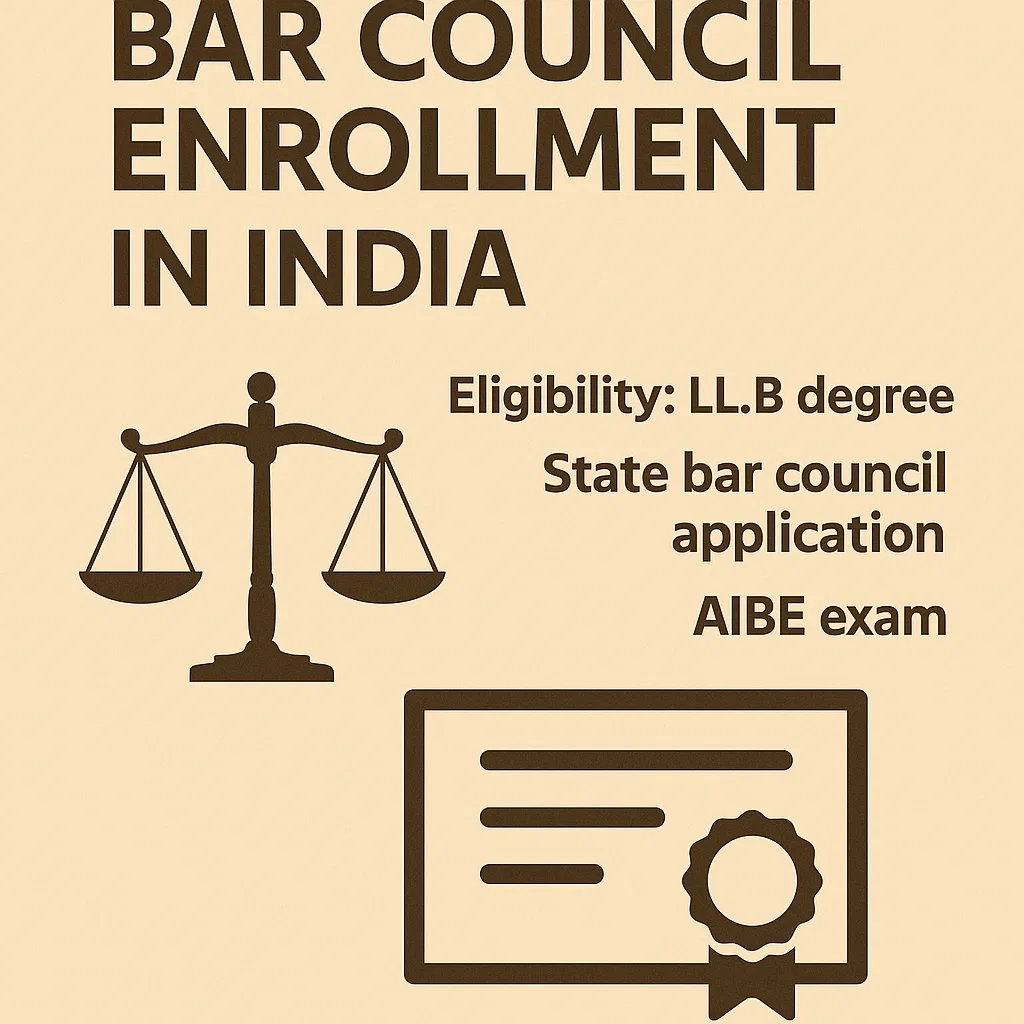
Bar Council enrollment is the formal gateway through which a law graduate transitions into the legal profession. Every law graduate, after completing their LL.B. degree from a recognized university, must apply for enrollment with the State Bar Council of the state where they wish to practice. This process includes submitting necessary documents, paying fees, going through verification, and eventually being entered into the official roll of advocates. Once enrolled, the individual is eligible to appear for the All India Bar Examination (AIBE) conducted by the Bar Council of India (BCI). Only after passing this exam does the advocate receive a Certificate of Practice, allowing them to represent clients in courts across India.
However, despite the straightforward legal framework, the actual enrollment process has faced several challenges and controversies particularly around enrollment fees, inconsistent practices across states, and delays in verification and approval. One of the most debated issues has been the excessive fees charged by State Bar Councils. The Advocates Act, under Section 24(1)(f), clearly states the enrollment fees: ₹600 for the State Bar Council and ₹150 for the Bar Council of India (for general category candidates), with significantly lower amounts for candidates from Scheduled Castes and Scheduled Tribes. But in practice, many State Bar Councils had been collecting amounts ranging from ₹10,000 to ₹50,000 or more, labeling them as welfare fees, administrative charges, or optional payments. This made it extremely difficult for students from poor or rural backgrounds to enter the profession, raising serious concerns about equal opportunity and access to justice.
This issue eventually reached the Supreme Court of India, which in a landmark ruling in 2024, declared that no State Bar Council or the Bar Council of India has the authority to collect any amount exceeding what is legally prescribed. The Court emphasized that any additional or optional fees were not only illegal but also violative of fundamental rights under Article 14 (Right to Equality) and Article 19(1)(g) (Right to Practice Any Profession) of the Indian Constitution. The Court’s judgment was a significant step toward restoring the integrity of the enrollment process and ensuring that financial barriers do not prevent deserving candidates from becoming advocates.
The Court’s ruling was followed by fresh guidelines in 2025, clarifying that enrollment should strictly follow the Advocates Act, and no fees whether labeled “optional,” “welfare,” or “processing”—can be collected unless authorized by law. This has prompted many State Bar Councils to revise their practices, although there are still challenges in uniform implementation.
In addition to fees, the enrollment process has seen other developments as well. Some Bar Councils have introduced internship requirements, character verification, or police clearance to ensure that only deserving candidates enter the legal field. Others are slowly moving toward online applications and digital verification systems, in an attempt to make the process more transparent and efficient. While these measures aim to maintain high professional standards, they must be balanced against the risk of creating unnecessary obstacles or delays.
Moreover, the Bar Council of India is now expected to play a stronger role in ensuring that all State Bar Councils comply with the law and act uniformly. While decentralization allows for local flexibility, it must not result in legal or procedural disparities that harm aspiring lawyers. The BCI is also expected to streamline coordination between enrollment and the AIBE process, so that candidates do not face multiple layers of confusion.
In this context, the enrollment system in India is undergoing a much-needed transformation. With the intervention of the judiciary, stricter legal enforcement, and growing public awareness, the process is becoming more transparent, affordable, and accountable. Yet, there is still a long way to go in making the legal profession truly accessible to all, especially those from disadvantaged or marginalized communities.
Enrollment Fees: What Does the Law Permit?
One of the most debated and controversial issues in the Bar Council enrollment process is the fee charged from law graduates. While the law clearly mentions what the enrollment fee should be, for many years, different State Bar Councils have been collecting much higher amounts, often using terms like welfare fee, ID card charge, or administrative expenses. This raised serious concerns about fairness, legality, and access to the profession for students who could not afford such high costs.
According to the Advocates Act of 1961, specifically under section 24(1)(f), the law sets a fixed enrollment fee that law graduates must pay at the time of applying to the State Bar Council. The prescribed fees are as follows:
For general category applicants:
600 rupees to the State Bar Council
150 rupees to the Bar Council of India
Total: 750 rupees
For Scheduled Caste or Scheduled Tribe applicants:
100 rupees to the State Bar Council
25 rupees to the Bar Council of India
Total: 125 rupees
These amounts are clearly mentioned in the law and were intended to make the legal profession accessible to all, including those from poor or rural backgrounds. However, in practice, many State Bar Councils started charging extra fees. In some cases, the total fee demanded from a candidate went as high as 20,000 to 50,000 rupees. These amounts were justified by the councils under various headings like welfare fund, library fee, infrastructure development, or document verification.
The problem with these charges was not just the financial burden they placed on law graduates, but also the fact that the Advocates Act does not give State Bar Councils or even the Bar Council of India the authority to collect any amount over and above the legal limit. This led to confusion and inequality. For example, a student in one state could get enrolled by paying just 750 rupees, while another student in a different state had to pay 30,000 rupees or more for the same process.
This issue reached the Supreme Court, and in July 2024, the court gave a very important ruling. It said that no Bar Council, whether at the state level or the national level, has the power to charge more than what is mentioned in section 24(1)(f) of the Advocates Act. The court also said that collecting any other amount, whether called optional or voluntary, is against the law. It added that this practice violated the right to equality under Article 14 of the Constitution and the right to practice any profession under Article 19(1)(g).
The Supreme Court made it clear that all State Bar Councils must follow the law and stop collecting illegal or excessive fees. The court’s order was also forward-looking, meaning that it would apply to future enrollments. Bar Councils were not required to refund the extra fees already collected in the past, but they had to follow the proper fee structure from then on.
Even after this judgment, some State Bar Councils continued to add optional charges or asked for additional fees during enrollment. This led to further hearings, and in 2025, the Supreme Court gave another direction. It said there is no such thing as an optional fee. Any amount collected over and above the legal limit is a violation and must be stopped immediately. The court even warned of strict action if the councils did not follow the law.
The importance of regulating enrollment fees goes beyond money. It affects who can enter the legal profession. If the fees are too high, many talented and capable students may not be able to afford it. This reduces diversity and keeps the profession limited to people from wealthier backgrounds. On the other hand, by keeping the fees within the legal limit, the system becomes fair, equal, and based on merit.
The court’s decision in this matter was a big step towards making the legal profession more inclusive. It showed that Bar Councils are not above the law and must work within the framework of the Advocates Act. It also ensured that aspiring advocates across the country are treated equally, regardless of which state they come from.
Supreme Court Intervention: Limiting Excessive Fees
The issue of exorbitant enrollment fees charged by various State Bar Councils finally attracted the attention of the Supreme Court of India, which stepped in to provide clarity and enforce the legal limits set by the Advocates Act, 1961. The Supreme Court’s intervention is one of the most significant developments in recent times for aspiring advocates, as it addressed the concerns of affordability, legality, and equal access to the legal profession.
Background to the Intervention
For years, law graduates across India faced large variations in enrollment fees depending on the state. Many students were forced to pay several thousands of rupees, often under headings like “welfare fund” or “library fee,” which were not officially authorized by law. These fees were a major barrier, especially for those from low-income families or marginalized communities. Complaints and petitions from affected students led to a judicial examination of whether such fees were legal.
The Supreme Court’s Landmark Judgment in 2024
In July 2024, the Supreme Court delivered a landmark judgment which was widely welcomed by legal professionals and students. The court clearly stated that:
The Advocates Act, under section 24(1)(f), sets the maximum fee that can be charged for enrollment.
Neither the State Bar Councils nor the Bar Council of India have the power to impose any fee exceeding this prescribed amount.
Additional fees, whether called “voluntary,” “optional,” or “welfare,” are illegal and cannot be demanded from candidates.
The excessive fees violated Articles 14 and 19(1)(g) of the Constitution, which guarantee equality before the law and the right to practice any profession.
This ruling effectively banned the collection of unauthorized fees and ensured that enrollment fees remain affordable and uniform across all states.
Court’s Emphasis on Access to the Legal Profession
The Supreme Court emphasized that practicing law is a fundamental right under the Indian Constitution. It pointed out that any unnecessary financial burden imposed on law graduates could deprive them of this right. By ensuring fees are capped and standardized, the court sought to promote fairness and prevent discrimination against economically weaker candidates.
The court also highlighted that Bar Councils, as regulatory bodies, must act transparently and within the law. They should protect the rights of aspiring advocates and avoid practices that create financial hurdles.
Follow-Up Directions and Enforcement
Following the 2024 judgment, the Supreme Court continued to monitor the situation. By 2025, the court issued further directions requiring all State Bar Councils to:
Immediately stop charging any fees beyond the legal limit.
Cancel enrollment applications if candidates refuse to pay unauthorized fees.
Ensure that no candidate is denied enrollment for refusing to pay extra charges.
Publish clear and transparent fee structures on official websites or notice boards.
The court warned that failure to comply would invite strict action, including contempt proceedings.
Impact of the Supreme Court’s Intervention
The Supreme Court’s rulings have had a significant impact on making the enrollment process more transparent and affordable. Several State Bar Councils have revised their fee structures and removed extra charges. The decision has also raised awareness among law students and the legal community about their rights.
However, the implementation remains uneven. Some Bar Councils still attempt to charge additional fees under different names or delay enrollment for candidates who do not pay them. This has led to calls for stronger oversight and enforcement by the Bar Council of India.
The Role of the Bar Council of India
The Supreme Court’s intervention has also prompted the Bar Council of India to take a more active role in supervising State Bar Councils. The BCI has been urged to issue uniform guidelines and ensure compliance with the Advocates Act. This includes:
Enforcing a standard fee structure nationwide.
Simplifying and digitizing the enrollment process.
Providing support to candidates facing irregular demands.
Enrollment Process and Rules: Step-by-Step Guide
Enrollment with the State Bar Council is the official process by which a law graduate becomes a recognized advocate and gains the right to practice law in India. While the Advocates Act, 1961, provides the legal framework, each State Bar Council may have minor variations in procedural requirements. However, the overall steps and rules remain broadly similar. This section will explain the entire enrollment process, the documents required, and important rules every candidate must follow.
Eligibility Criteria
Before starting the enrollment process, a candidate must meet the basic eligibility conditions laid down in the Advocates Act:
The candidate must have completed a law degree (LL.B.) from a university recognized by the Bar Council of India.
The degree must be a 3-year or 5-year LL.B. course as per the University Grants Commission guidelines.
The candidate should not have been disqualified or convicted for any criminal offence that bars legal practice.
Step 1: Submission of Application
The candidate must apply for enrollment to the State Bar Council of the state where they intend to practice. Some states have started accepting online applications, while others still use physical forms. The application must be submitted along with the following:
Degree certificate or provisional certificate from the university.
Mark sheets of law examinations.
Proof of identity (such as Aadhar card, passport, voter ID).
Passport-size photographs.
Character certificate or affidavit declaring good conduct.
Enrollment fees as prescribed by the Advocates Act (₹750 for general candidates and ₹125 for SC/ST).
Step 2: Verification of Documents
After receiving the application, the Bar Council conducts a verification process. This involves:
Checking the authenticity of the law degree and mark sheets.
Verifying the candidate’s identity and residence.
Ensuring the candidate has no criminal background.
Sometimes, police verification or character checks may be required.
This step is important to maintain the integrity of the legal profession and prevent unqualified or dishonest persons from enrolling.
Step 3: Enrollment Committee Meeting
Once verification is complete, the candidate’s application is placed before the Enrollment Committee of the State Bar Council. This committee reviews all documents and decides whether the candidate is eligible to be enrolled as an advocate.
If approved, the candidate’s name is entered into the Roll of Advocates maintained by the State Bar Council. The roll is a public document that officially recognizes the candidate as a legal practitioner.
Step 4: Issuance of Enrollment Certificate
After enrollment, the candidate receives an Enrollment Certificate from the State Bar Council. This certificate serves as proof that the candidate is officially an advocate and entitled to practice law in any court in India.
Step 5: All India Bar Examination (AIBE)
Enrollment alone does not give the right to practice in courts. According to Bar Council of India rules, newly enrolled advocates must pass the All India Bar Examination (AIBE) conducted by the Bar Council of India within two years of enrollment.
The AIBE is an open-book exam that tests the advocate’s basic knowledge of law and professional ethics. Passing this exam earns the candidate a Certificate of Practice, allowing them to appear before courts at all levels.
Important Rules and Guidelines
A candidate must be truthful and provide genuine documents during enrollment.
Misrepresentation or submission of fake certificates leads to cancellation of enrollment and legal action.
Candidates are expected to maintain professional conduct and adhere to the rules of the Bar Council.
If an advocate changes the state where they want to practice, they must apply for transfer of enrollment to the new State Bar Council.
The enrollment fees are fixed by law, and no additional fees should be demanded.
Bar Councils have the power to suspend or cancel enrollment for professional
.
Challenges in the Enrollment Process
Despite legal reforms, some challenges persist:
Delay in document verification and committee meetings
Lack of uniformity in processing times across states
Occasional demand for extra fees or unofficial charges
Incomplete awareness among students about the process and fees
Ongoing efforts by the Bar Council of India and the Supreme Court aim to address these issues and standardize the enrollment system nationwide.
Conclusion
The enrollment process with the Bar Council is a crucial step for any law graduate seeking to enter the legal profession in India. It not only grants the legal right to practice but also brings with it the responsibility to uphold the ethics and dignity of the profession. Over the years, issues surrounding enrollment fees, procedural delays, and varying state practices have created barriers for many aspiring advocates, especially those from marginalized or economically weaker sections.
The Advocates Act, 1961, provides a clear legal framework, including a fixed fee structure for enrollment, but non-compliance by several State Bar Councils had complicated matters. The Supreme Court’s timely intervention to limit excessive and unauthorized fees has been a major step toward ensuring equal access and fairness in the legal profession. By affirming that no additional fees beyond the statutory amount can be charged, the court has reinforced the constitutional rights of aspiring advocates and upheld the principle of equality.
Furthermore, the enrollment process, while structured under clear rules, continues to evolve with digitization and improved transparency. The introduction of online applications, faster verification, and standardized procedures across states will make enrollment more accessible and efficient in the coming years.
Nevertheless, challenges such as delays, lack of uniformity, and occasional attempts to bypass legal limits on fees remain. Continuous monitoring by the Bar Council of India and adherence to Supreme Court guidelines
SOURCES
Advocates Act, 1961 – The primary legislation governing the enrollment and regulation of advocates in India.
Bar Council of India Rules – Official rules framed under the Advocates Act, including enrollment regulations.
Supreme Court of India judgments on enrollment fees and related matters:
Bar Council of India vs. A.K. Balaji (2024) – Landmark judgment on limiting enrollment fees.
State Bar Council vs. Advocates’ Association (2025) – Further directions on compliance with fee regulations.
Reports and circulars issued by the Bar Council of India on enrollment procedures and digitization initiatives.
Legal commentaries and articles on enrollment fee controversies and reforms published in law journals such as:
Journal of Indian Law and Society
Indian Bar Review
Books on legal profession regulation in India:
The Advocates Act and Professional Ethics
Legal Profession in India: Law and Practice
News reports and analyses from reputed national newspapers and legal news portals covering Supreme Court rulings and Bar Council reforms.